
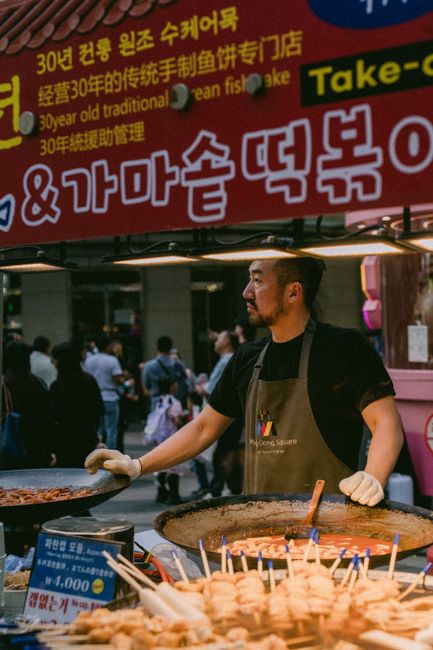
At 11 p.m. on a Tuesday, the streets of Gangnam (\uac15\ub0a8) are still loud. Not bar-loud. Food-loud.
Steam rising from iron griddles. The crack of tteokbokki (떡볶이) sauce hitting a hot pan. A vendor shouting something in Korean that even the locals around you seem to half-ignore — because they already know what they want. This is not a tourist market dressed up for cameras. This is Seoul after dark, eating the way it actually eats.
The 2026 Seoul night market circuit has expanded beyond its traditional strongholds. Myeongdong (\uba85\ub3d9) still draws the crowds, but the real evolution is happening south of the Han River. Gangnam-gu and its surrounding neighborhoods have built a parallel night food culture — one that mixes the raw energy of pojangmacha (\ud3ec\uc7a5\ub9c8\ucc28) stall culture with the polished confidence of a district that knows it has money and still chooses to eat standing up.
Why Gangnam Eats at Midnight
Seoul is a city that does not sleep on schedule. According to Seoul Metropolitan Government data from 2024, foot traffic in Gangnam-gu between 10 p.m. and 2 a.m. on weekdays rivals that of most Asian capital districts at peak lunch hour. The district draws roughly 3.2 million daily visitors — more than the entire population of Berlin passing through a single administrative zone every 24 hours.
That pressure needs somewhere to go. It goes to food.
The night market culture here is not a seasonal festival. It is structural. Office workers who leave their desks at 9 p.m. do not go home to cook. They stop at the stall outside the subway exit, order something hot, something cheap relative to their income, and eat it in four minutes standing over a plastic tray. This is the foundational transaction of Seoul’s night economy, and it has been running continuously since the postwar pojangmacha culture of the 1950s — when street stalls were not a lifestyle choice but a survival mechanism for a city rebuilding itself from rubble.
That origin story matters. Desperation built this food culture. The vendors who first lit charcoal burners on Seoul’s sidewalks were not entrepreneurs with business plans — they were people with nowhere else to go, selling what they could afford to make. The food they invented under those conditions — cheap, fast, intensely flavored, designed to be eaten while standing — turned out to be exactly what a city running at full speed would want forever.
“Street food is the autobiography of a city’s hardest years, written in sauce and smoke.”
The Gangnam Night Market Route: Where It Actually Happens
Foreign visitors often make the mistake of treating Gangnam as a single destination. It is not. It is a cluster of distinct neighborhoods, each with its own night food personality. The three anchors worth knowing are Sinchon (신촌) — technically Mapo-gu but functionally adjacent in the night circuit — Apgujeong Rodeo (압구정 로데오), and the area surrounding Gangnam Station (강남역) Exit 10.
Gangnam Station’s Exit 10 radius operates on pure volume. This is the highest-density convergence point in the district. On a Friday night between 8 p.m. and midnight, the stretch of food stalls running along Gangnam-daero (강남대로) toward Sinnonhyeon (신논현) handles thousands of transactions per hour. Hotteok (호떡) — a filled pancake that costs roughly ₩1,500 (about $1.10 USD as of 2025 rates) — sells faster here than most cafés sell coffee.
📍 Gangnam Station Night Food Strip
- Address: Gangnam-daero, Gangnam-gu, Seoul (강남대로, 강남구, 서울특별시)
- Hours: Stalls typically active 6 p.m. – 2 a.m. daily; peak 9 p.m. – midnight
- Admission: Free to enter; food priced per item (₩1,000–₩8,000 range)
- Getting there: Seoul Metro Line 2 / Sinbundang Line — Gangnam Station, Exit 10
- Official site: https://www.gangnam.go.kr
Apgujeong Rodeo runs a different frequency. The stalls here are fewer, but the food is more curated. This is where you find vendors who have been working the same recipe for twenty-plus years alongside newer operators selling fusion formats — Korean corn dogs (핫도그) stuffed with mozzarella and coated in ramen noodle crumbs, or tteokbokki served in a paper cup with a drizzle of carbonara sauce that would horrify a Roman and delight everyone else. The average spend per person at Apgujeong’s night stalls runs higher — closer to ₩12,000–₩18,000 per session — but the flavor density per square meter is hard to argue with.
📍 Apgujeong Rodeo Street (압구정 로데오거리)
- Address: Apgujeong-ro, Gangnam-gu, Seoul (\uc555\uad6c\uc815\ub85c, \uac15\ub0a8\uad6c, \uc11c\uc6b8\ud2b9\ubcc4\uc2dc)
- Hours: Evening stalls active approximately 7 p.m. – 1 a.m.
- Admission: Free
- Getting there: Seoul Metro Line 3 — Apgujeong Station, Exit 2; or Bundang Line — Apgujeong Rodeo Station, Exit 2
- Official site: https://www.gangnam.go.kr/tour
The Language Barrier at 1 A.M. — What Actually Happens
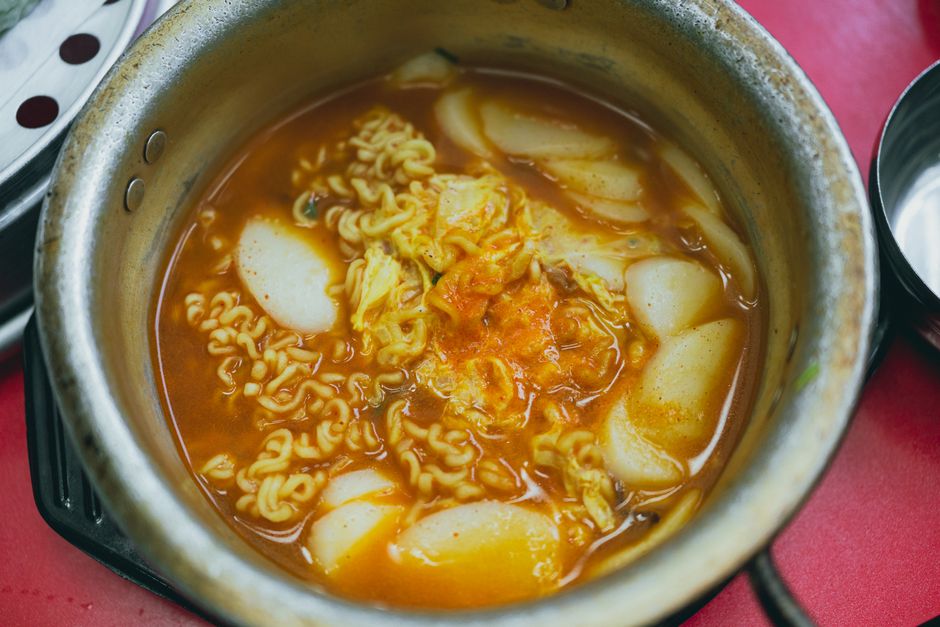
Here is the scenario no travel guide prepares you for: it is 1:15 a.m., you are standing in front of a pojangmacha stall, the vendor speaks zero English, the menu is handwritten in Korean, and you are hungry enough to eat the plastic tray.
Seoul’s street food culture has a functional solution built into it, and it has nothing to do with translation apps. It is pointing. Every stall worth eating at has the food visible — either in a display case, on a griddle, or in a pot you can see directly. The transaction that built this culture in the 1950s did not require literacy. A widow selling odeng (오뎅 — fish cake skewers in broth) on a cold sidewalk did not need her customers to read. She needed them to see the steam, smell the broth, and hand over coins.
That same logic still operates. Point at what is in the pot. Hold up fingers for quantity. The vendor will charge you correctly — overcharging tourists is genuinely uncommon at street stalls because the margins are already thin and reputation is everything at a fixed location. If the price surprises you, the vendor will almost always show you a number on their phone calculator. This system works at 1 a.m. when every translation app is struggling with the vendor’s regional accent anyway.
The real language barrier in Seoul’s night market is not ordering. It is knowing when to book tours in advance and experience the full circuit. For those planning to explore, stay connected with mobile data so you can navigate, translate menus, and call for rides home after midnight.
Five Things Worth Eating Before Midnight
Not a ranked list. A field report.
- Eomuk (어묵) / Odeng: Fish cake skewers in a light kelp broth. The broth is free — vendors expect you to drink it. It costs ₩500–₩1,000 per skewer. It is the most underrated thing on any street in Seoul.
- Jeon (전) — Korean savory pancakes: Best found at pojangmacha stalls rather than restaurants. Kimchi jeon (김치전) and haemul pajeon (해물파전 — seafood scallion pancake) are the two versions that justify standing in the cold.
- Dak-kkochi (닭꼬치): Grilled chicken skewers glazed in a soy-garlic or spicy sauce. One skewer is never enough. Two is the correct number.
- Hotteok (호떡): The filled pancake that defines Seoul winter nights. The classic version has brown sugar, cinnamon, and crushed peanuts inside. The green tea and red bean variant is newer and worth trying once.
- Soondae (순대): Blood sausage stuffed with glass noodles and vegetables. It looks alarming on first encounter. It is one of the most deeply satisfying things the Korean street food tradition has ever produced.
The Pojangmacha Problem — and Why It Is Getting Worse
There is a version of this article that would tell you Seoul’s pojangmacha culture is thriving and expanding. That version would be incomplete.
Seoul Metropolitan Government data from 2023 indicated that the number of licensed pojangmacha stalls in the city had declined by approximately 40% over the preceding decade. Rent pressure, hygiene regulations, and urban redevelopment have systematically reduced the number of sidewalk stalls in prime districts. Gangnam has been hit harder than most — the district’s real estate values make even a sidewalk permit economically complicated.
What has replaced some of the lost stalls is a sanitized version: indoor food halls designed to look like outdoor markets, with LED lighting that mimics the warmth of a charcoal burner without the smoke, and QR code menus that solve the language problem while stripping out the human transaction that made the original culture worth having. They are not bad places to eat. They are just not the same thing.
The authentic stall culture that remains in Gangnam exists in specific pockets — near transit exits, in the older alleys behind main commercial streets, and in the Nonhyeon (논현) area, where the neighborhood’s older residential character has slowed the full commercial transformation. These pockets are real. They are also shrinking.
📍 Nonhyeon-dong Night Alley Area (논현동)
- Address: Nonhyeon-ro, Gangnam-gu, Seoul (\ub17c\ud604\ub85c, \uac15\ub0a8\uad6c, \uc11c\uc6b8\ud2b9\ubcc4\uc2dc)
- Hours: Street stalls active approximately 8 p.m. – midnight; varies by vendor
- Admission: Free
- Getting there: Seoul Metro Line 7 — Hakdong Station, Exit 1
- Official site: https://www.gangnam.go.kr
After Midnight: The Norebang (노래방) Orbit
Seoul’s night food culture does not end at the stall. It continues into norebang — private karaoke rooms — and the late-night fried chicken and beer (chimaek, 치맥) sessions that follow. The circuit is predictable: street food from 9 to 11 p.m., drinks from 11 p.m. to 1 a.m., norebang from 1 to 3 a.m., and then either home or a 24-hour gukbap (국밥 — rice soup) restaurant for something warm before the first subway at 5:30 a.m.
For a foreign visitor, the norebang portion of this circuit requires exactly one skill: the ability to commit to something ridiculous with complete sincerity. The rooms are private. No one outside your group can hear you. The song catalog at most Gangnam noreangs now includes extensive English-language options. The tambourine provided is mandatory.
The 24-hour gukbap restaurant at the end of the night is not optional. It is structural. A bowl of pork bone soup with rice, eaten at 4 a.m. under fluorescent lights alongside eight other people who all made the same decision, is one of the most honest dining experiences Seoul offers. It costs around ₩9,000–₩12,000. It will fix everything that needs fixing.
Practical Notes for the Unprepared
Cash still matters at street stalls. Most pojangmacha vendors accept card payments via mobile terminal, but not all — and the ones that don’t are often the ones making the best food. Carry ₩30,000–₩50,000 in small bills on any serious night market run.
The T-money card (티머니) — Seoul’s transit IC card — can be loaded at any convenience store and used on all subway and bus lines. The last subway on most Gangnam lines runs around 11:30 p.m. to midnight. After that, taxis are abundant but surge-price during peak late-night hours. Kakao T (카카오 T), the dominant ride-hailing app in Korea, has an English interface and is more reliable than flagging a cab after 1 a.m.
One scenario worth knowing: if you eat something that disagrees with you at a street stall — rare, but possible — the 24-hour convenience stores (CU, GS25, 7-Eleven) stock basic digestive medications with pictogram instructions. Gangnam also has several 24-hour pharmacies (약국) near major transit hubs. Google Maps identifies them accurately. The staff will not speak English, but they will understand the universal gesture of pointing at your stomach with a pained expression.
Rover’s Take
A city that built its street food culture out of postwar desperation, watched it get regulated and redeveloped for sixty years, and still has vendors standing in the cold at 1 a.m. making fish cake broth from scratch — that city is not performing for tourists. It is just refusing to stop.