
Jeju Island (제주도) doesn’t ease you in. The moment the plane descends, the fields below are already burning yellow — tens of thousands of rapeseed flowers in full riot, weeks before the mainland even thinks about spring.
Every year between late March and mid-April, roughly 1.3 million visitors converge on this single island — a landmass smaller than the state of Rhode Island — chasing two things: yellow and pink. Rapeseed blossoms and cherry blossoms. They overlap for perhaps ten days. Miss that window and you’re looking at green fields and bare branches.
This is not a soft destination. It rewards the prepared and punishes the passive.
The Yellow Fields That Made Jeju Famous
Seongsan Ilchulbong (성산일출봉), the volcanic crater rising 182 meters from the sea at Jeju’s eastern tip, is usually photographed in isolation. In spring, the fields surrounding its base turn entirely yellow. The contrast — black volcanic rock, green crater rim, yellow ground — is the image that sells Jeju to the world. It has been reproduced so many times it has become almost abstract. Standing inside it is something else entirely.
The rapeseed fields here are not curated gardens. They are working agricultural land. Farmers in Jeju have grown yuche (유채) — the Korean term for rapeseed — for generations, primarily for oil. The spring tourist economy grew around a crop that was never planted for tourists. That tension — between function and spectacle — is visible in the fields themselves. Tractor paths cut through the blooms. Irrigation hoses run along the edges. The flowers don’t care about your photograph.
Peak bloom at Seongsan typically falls in the first two weeks of April. Sunrise here is a specific event. The crater is a UNESCO World Heritage Site, and the entrance fee is modest — but the real cost is the alarm clock.
📍 Seongsan Ilchulbong (성산일출봉)
- Address: 284-12 Seongsan-ri, Seongsan-eup, Seogwipo-si, Jeju
- Hours: 07:00 – 20:00 (last entry 19:00); hours may vary by season
- Admission: Adults 2,000 KRW; children 1,000 KRW
- Getting there: Intercity bus from Jeju City Bus Terminal — approximately 1 hour 20 minutes to the Seongsan Ilchulbong stop
- Official site: https://www.visitjeju.net
The fields around Seopjikoji (섭지코지) — a coastal headland roughly 3 kilometers from Seongsan — offer a different geometry. Here the rapeseed runs along a narrow peninsula with the sea on both sides. Wind is constant. The flowers move. On overcast days, the yellow reads almost neon against a grey ocean. It is one of the few places in Jeju where the landscape feels genuinely cinematic rather than postcard-flat.
📍 Seopjikoji (섭지코지)
- Address: Seopjikoji-ro, Seongsan-eup, Seogwipo-si, Jeju
- Hours: Open year-round; no set closing time
- Admission: Free
- Getting there: Taxi from Seongsan Ilchulbong — approximately 10 minutes; no direct bus route to the tip
- Official site: https://www.visitjeju.net
Cherry Blossoms: The Ten-Day Overlap
Jeju’s cherry blossoms bloom earlier than anywhere else in South Korea — typically late March, sometimes as early as the third week of the month. By the time Seoul’s Yeouido (여의도) turns pink in early April, Jeju’s petals are already on the ground.
The most concentrated cherry blossom corridor in Jeju runs along Jeonnong-ro (전농로) in Jeju City. A 1.2-kilometer stretch of road is lined on both sides with king cherry trees — wangbeot (왕벚나무) — a variety many botanists believe originated on Jeju itself. The canopy closes over the road when the trees are in full bloom. Walking through it at dusk, with the light coming in at a low angle, is one of those experiences that resists description — which is exactly why everyone attempts it anyway.
The Jeju King Cherry Blossom Festival (제주 왕벚꽃축제) is held annually along this road, typically in late March or early April depending on bloom timing. Local food stalls, live music, and crowds thick enough to slow movement to a shuffle. The festival is free. The crowds are not optional.
📍 Jeonnong-ro Cherry Blossom Road (전농로 벚꽃길)
- Address: Jeonnong-ro, Jeju-si, Jeju
- Hours: Outdoor road; accessible at all times
- Admission: Free
- Getting there: Approximately 15 minutes on foot from Jeju City Hall; local buses serve the area
- Official site: https://www.visitjeju.net
For those willing to venture beyond the city, Hallim Park (한림공원) on Jeju’s western coast combines cherry blossoms with subtropical garden grounds, lava tube caves, and folk village reconstructions. It is a managed attraction — entry is paid — and it functions accordingly. But the cherry tree density is high, and the morning light through the western groves before the tour buses arrive is genuinely worth the early departure. You can book tours in advance to secure access during peak hours.
📍 Hallim Park (한림공원)
- Address: 300 Hallim-ro, Hallim-eup, Jeju-si, Jeju
- Hours: 08:30 – 18:00 (last entry 17:00)
- Admission: Adults 12,000 KRW; children 6,000 KRW
- Getting there: Bus 102 or 202 from Jeju City Bus Terminal — approximately 50 minutes to the Hallim Park stop
- Official site: https://www.hallimpark.com
When the Language Barrier Becomes a Wall
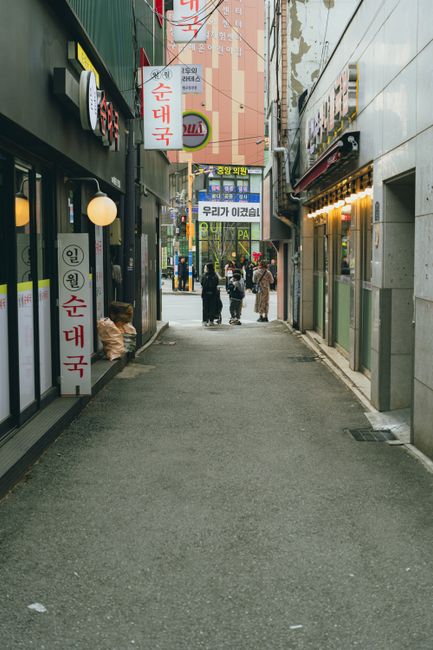
Jeju is not Tokyo. English signage is inconsistent. Outside of major tourist corridors, it disappears almost entirely. A foreign visitor who rents a car — the most practical way to reach rural rapeseed fields — will encounter road signs, GPS voice prompts, and fuel station interfaces that default to Korean with no English toggle.
The specific scenario: it is 9 PM, you are on the eastern coast near Udo Island (우도), your rental car’s low-fuel warning has been on for twenty minutes, and the nearest station is 8 kilometers down a road your offline map doesn’t cover. The attendant speaks no English. You speak no Korean. The pump interface has four options and none are labeled in Roman script.
The practical answer is crude and reliable: open Google Translate, switch to camera mode, point it at the screen. The translation will be imperfect. It will be enough. Korean fuel stations near tourist areas typically accept international credit cards at the pump — but the card slot is often labeled only in Korean. Look for the slot on the right side of the pump face. Press the button with the most characters. That is almost always the card payment option.
For genuine emergencies — medical, accident, serious loss — the Jeju Tourism Organization operates a 24-hour multilingual helpline. The number is 064-740-6000. Save it before you land. It costs nothing and the response time is fast.
Language is not a barrier here. It is a friction. The distinction matters.
Three Words That Define a Jeju Spring
Despair, trial, inspiration — these three words are not abstract when applied to Jeju’s spring landscape. They are the actual arc of the island’s agricultural history. The volcanic soil of Jeju is notoriously thin and rocky. For centuries, farming here was a form of organized suffering. Rapeseed was cultivated precisely because it could survive what other crops couldn’t — shallow soil, salt wind, late frosts. The yellow fields that now draw a million visitors annually were originally a survival strategy. The beauty was incidental.
That history is visible if you know where to look. The stone walls — batdam (밭담) — that divide Jeju’s fields are not decorative. They are windbreaks built from volcanic rock over generations, each stone placed by hand. UNESCO recognized the Jeju Batdam Agricultural System as a Globally Important Agricultural Heritage System in 2014. The walls run for approximately 22,000 kilometers across the island — longer than the Great Wall of China by some estimates, though built by farmers rather than armies.
Walking through a rapeseed field bordered by batdam in full spring bloom is one of those experiences where the aesthetic and the historical occupy the same space simultaneously. The flowers are beautiful. The walls are a record of hardship. They are the same view.
Timing Is Not Flexible
The bloom window is real and it is narrow. Rapeseed in Jeju peaks between late March and mid-April. Cherry blossoms peak between late March and early April. The overlap — when both are simultaneously at full bloom — lasts approximately seven to ten days. Weather determines the exact dates each year, and they can shift by up to two weeks between years.
The Korea Meteorological Administration publishes annual bloom forecasts, typically released in late February. The Jeju Tourism Organization updates field conditions weekly during the season. Neither source is perfectly accurate. Both are worth checking.
What is consistent: crowds peak on weekends and Korean public holidays. Accommodation prices in Jeju City and Seogwipo during peak bloom weekends can run 40 to 60 percent higher than the same rooms in early March. Weekday visits — Tuesday through Thursday — offer thinner crowds and standard pricing. The flowers don’t know what day it is.
Rover’s Take
Jeju in spring is one of the most photographed places in Asia during a ten-day window — and one of the most honestly earned landscapes you will ever stand inside, if you bother to read the walls.