
Thousands of foreign tourists now travel to Korea not for palaces or temples — but to stand exactly where their favorite actor stood.
The K-drama location pilgrimage is no longer a niche hobby. It has become one of the most organized, emotionally charged forms of travel in Asia. Two cities sit at the center of it: Busan (부산) and Jeju Island (제주도). One is gritty and cinematic, built on hills and sea. The other is volcanic, wide open, and almost unreally photogenic. Together, they account for a disproportionate share of Korea’s most iconic drama backdrops — drawing visitors who have already watched every episode twice before booking their flights.
This is not a list of pretty spots. This is a field guide for people who want the real coordinates.
Why Busan? Because the Camera Loves It
Busan is Korea’s second-largest city, with a population of roughly 3.4 million (2023, Statistics Korea). In the world of K-drama, though, it punches far above its size. The city’s compressed geography — mountains dropping directly into the sea, narrow alleyways stacked on hillsides, fishing ports wedged beside luxury hotels — gives directors a visual range that Seoul simply cannot replicate.
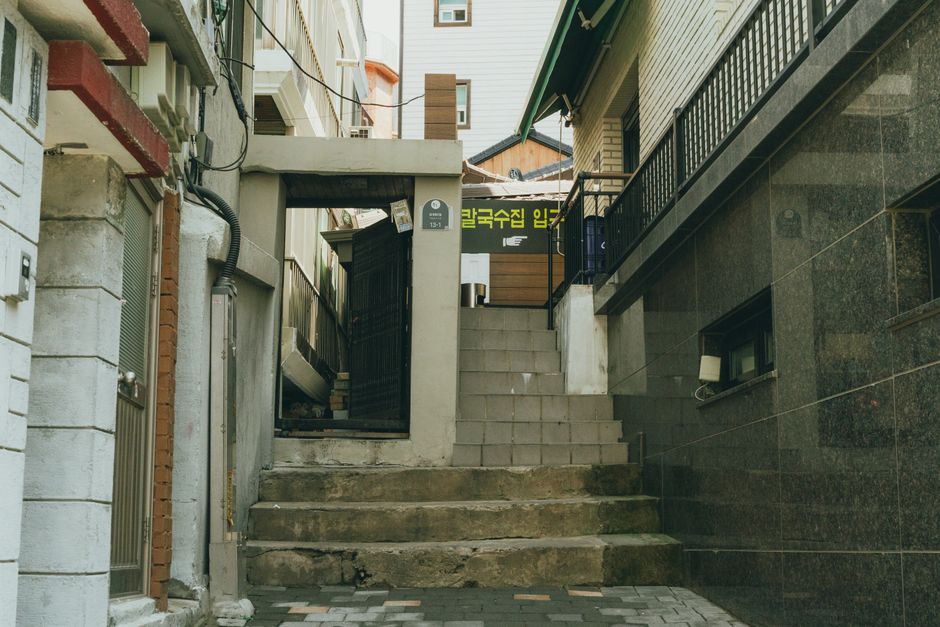
The most visited drama location in Busan is Gamcheon Culture Village (감천문화마을). Originally a hillside settlement built by refugees during the Korean War, it was transformed starting around 2009 into a labyrinth of painted houses, murals, and steep staircases. It has appeared in multiple dramas as the “forgotten neighborhood” backdrop — a place that looks like it exists outside of time. Foreign visitors often arrive expecting a theme park. They find something stranger and more real: the smell of damp concrete, laundry strung between windows, cats sleeping on warm stone steps.
📍 Gamcheon Culture Village
- Address: 203 Gamnae 2-ro, Saha-gu, Busan
- Hours: Open year-round (individual shops and galleries have varying hours; most active 9:00 AM – 6:00 PM)
- Admission: Free to enter the village; some art installations charge a small fee
- Getting there: Take Busan Metro Line 1 to Toseong Station, then bus 2 or 2-2 to Gamcheon Culture Village stop
- Official site: https://www.gamcheon.or.kr
Haeundae Beach (해운대 해수욕장) is Busan’s most recognizable coastline and has appeared in so many productions that listing them all would require a separate article. What matters for the drama pilgrim is the eastern end — near the Dongbaek Island (동백섬) walkway. The rocky coastal path there, with APEC Naru Park on one side and open sea crashing on the other, has been used repeatedly as the “contemplative walk” scene that every Korean melodrama requires. Come at sunrise. The light is different from anything a studio frame can fake.
📍 Haeundae Beach
- Address: Haeundaehaebyeon-ro, Haeundae-gu, Busan
- Hours: Open year-round (swimming season officially July–August)
- Admission: Free
- Getting there: Busan Metro Line 2 to Haeundae Station, Exit 3 or 5, then a 5-minute walk
- Official site: https://www.haeundae.go.kr
The Huinnyeoul Culture Village (흰여울문화마을) in Yeongdo-gu is less famous internationally but more specifically tied to drama scenes. Perched on cliffs above the Korea Strait, the narrow lane running along the cliff edge appeared in the film Ode to My Father and has since shown up in several streaming dramas. The view from the path is a ready-made composition: sea below, cargo ships drifting in the distance, pastel walls close enough to touch on your left. The village is small. You can walk the entire main path in under 20 minutes — which is exactly why it works so well on screen.
📍 Huinnyeoul Culture Village
- Address: Jeollyeongno 10beon-gil, Yeongdo-gu, Busan
- Hours: Open year-round (outdoor path accessible at all times)
- Admission: Free
- Getting there: From Nampo Station (Metro Line 1), take bus 7 or 71 toward Yeongdo; alight at Huinnyeoul Village stop
- Official site: https://www.yeongdo.go.kr
The Real Logistics Problem Nobody Warns You About
Here is the scenario that catches foreign visitors off guard in Busan: you land at Gimhae International Airport (김해국제공항) at 11 PM, your accommodation is in Haeundae, and the airport limousine bus stopped running an hour ago. The last bus on Route 307 departs around 9:30 PM. After that, your options are a taxi (roughly 35,000–45,000 KRW depending on traffic) or a rideshare via Kakao T — which requires a Korean phone number to register unless you use the international version of the app, which has limited coverage in Busan compared to Seoul.
Set up Kakao T before you land. Download it in your home country, complete registration with an international number, and add a payment card. If that fails, go straight to the official taxi queue outside Arrivals — do not accept offers from unlicensed drivers who approach you inside the terminal. The queue moves fast after midnight.
Busan’s drama filming locations are also spread across multiple districts. Gamcheon is in Saha-gu. Huinnyeoul is in Yeongdo-gu. Haeundae sits on the opposite side of the city entirely. A single day of location-hopping without a plan will cost you 3–4 hours in transit alone. Rent a car if you have an international driving permit, or book tours in advance to streamline your itinerary.
Jeju: Where Dramas Go to Be Beautiful and Tragic
Jeju Island sits 82 kilometers south of the Korean mainland. Korea’s largest island — roughly 1,849 square kilometers — its landscape is so distinct from the rest of the country that directors use it as visual shorthand for “escape.” When a character needs to disappear, heal, or fall in love against impossible odds, they go to Jeju.
Seopjikoji (섭지코지) on the eastern coast is arguably the single most drama-dense location on the island. The coastal headland — a flat grassy promontory ending in volcanic rock cliffs — has appeared in All In, My Sassy Girl, and more recently in several Netflix Korea productions. The Genius Loci building designed by Tadao Ando sits at the entrance and is itself a visual landmark. Walk past it toward the lighthouse. The wind is constant out there, bending the grass in one direction like a slow exhale. It photographs like a painting even in bad weather.
📍 Seopjikoji
- Address: Seopjikoji-ro, Seongsan-eup, Seogwipo-si, Jeju
- Hours: Open year-round (outdoor area; accessible at all times)
- Admission: Free (parking fee may apply)
- Getting there: From Jeju City, take intercity bus 701 toward Seongsan; transfer at Seongsan-ri terminal and take a local bus or taxi to Seopjikoji
- Official site: https://www.visitjeju.net
Jeju Olle Trail (제주 올레길) Route 7 runs along the Seongsan coastline through landscapes that have appeared in too many dramas to attribute cleanly. What matters is the walk itself: 17.6 kilometers of coastal path with views of Seongsan Ilchulbong (성산일출봉) — the UNESCO-listed tuff cone that rises 182 meters above sea level and anchors the background of countless drama establishing shots. The trail is well-marked in Korean and English. At a normal pace, expect 5–6 hours.
📍 Seongsan Ilchulbong
- Address: 284-12 Seongsan-ri, Seongsan-eup, Seogwipo-si, Jeju
- Hours: Varies by season; generally 7:00 AM – 8:00 PM (last entry 1 hour before closing)
- Admission: Adults 2,000 KRW; children 1,000 KRW
- Getting there: Intercity bus 701 from Jeju City Bus Terminal; alight at Seongsan Ilchulbong stop
- Official site: https://www.jejuolle.org
Jeju’s western coast operates at a different register entirely. Hyeopjae Beach (협재해수욕장) near Hallim is known for water that reads almost artificially turquoise in photographs — except it looks exactly that vivid in person, too. The beach has appeared in lighter romantic dramas as the “summer memory” location, and it earns the designation. Water temperature peaks in August at around 25°C, slightly warmer than Haeundae’s 23°C that same month. Facing Biyangdo Island (비양도) — a small volcanic island 3 kilometers offshore — every wide shot here comes with a natural focal point built in.
📍 Hyeopjae Beach
- Address: 2447 Hallim-ro, Hallim-eup, Jeju-si, Jeju
- Hours: Open year-round
- Admission: Free (parking fee applies in summer)
- Getting there: Intercity bus 702 from Jeju City Bus Terminal; alight at Hyeopjae Beach stop
- Official site: https://www.visitjeju.net
5 Things That Will Actually Slow You Down
- No English signage in rural Jeju: Outside major tourist zones, English disappears from signs entirely. Download Naver Maps — not Google Maps. Google’s Korea data is legally restricted and significantly less accurate for rural routes.
- Jeju’s bus frequency: Inter-city buses run every 20–40 minutes on major routes, but local connecting buses can come once an hour. Miss one in a location-hopping itinerary and you’re looking at a 90-minute delay that cascades through the rest of your day.
- Busan’s hills: Gamcheon and Huinnyeoul both involve steep climbs. Neither is wheelchair accessible. Comfortable shoes aren’t a suggestion — they’re the difference between finishing the route and stopping halfway up a staircase.
- Filming location drift: Production companies don’t always shoot where they claim in press materials. Some scenes officially attributed to Seopjikoji were filmed at composite locations. Cross-reference with fan community databases like Dramabeans or Korean drama location wikis before making any single scene your primary destination.
- Seasonal crowds at Seongsan Ilchulbong: Sunrise viewing in January and February draws queues that form before 5 AM. The summit path is narrow. Arrive at 6:30 AM during peak season and you’ll watch the sun rise from the base — not the crater rim.
The Practical Stack: What to Carry, What to Book
A T-money card (티머니 카드) works on Jeju’s buses and Busan’s metro. Load it at any convenience store — GS25, CU, 7-Eleven — using cash. The card itself costs 2,500 KRW. Bus fares in Jeju are a flat 1,200 KRW per ride for adults (2024 rate); in Busan, metro fares start at 1,500 KRW. A week of location-hopping across both destinations without a transit card will cost you significantly more in taxi fares and wasted time than you’d expect.
For Jeju specifically: rent a car. The island’s public bus system covers major routes but not the connective tissue between drama locations. A compact car runs approximately 40,000–70,000 KRW per day depending on season and provider. An International Driving Permit is required for foreign license holders — Korean rental agencies do not accept foreign licenses alone. Process it before you leave home.
On accommodation: base yourself in Haeundae for Busan and in Seogwipo for Jeju’s eastern locations. Both areas have the highest density of filming sites within a 30-minute radius. Seogwipo also gives you faster access to Seopjikoji and Seongsan Ilchulbong than staying in Jeju City, which sits on the opposite end of the island. Before departure, make sure you stay connected with a Korean eSIM to access maps and transit information throughout your trip.
The best drama location visit is the one where you forget you’re retracing a scene — and start just looking at the place itself.
Rover’s Take
You flew thousands of kilometers to stand in a spot a camera crew left three years ago — and somehow, standing there, it still means something. That’s not delusion. That’s what good storytelling does to geography.