
Korea has 16 UNESCO World Heritage Sites. That number alone puts it ahead of most countries people actually bother to visit.
By 2026, the government has committed to expanding heritage site infrastructure — new multilingual signage, upgraded visitor centers, and extended shuttle routes connecting sites that once required a rental car and three wrong turns. The window for experiencing these places before the crowds catch up is closing. Fast.
Why UNESCO Designation Actually Matters Here
UNESCO doesn’t hand out designations for being old. The criteria demand outstanding universal value — a site must represent something irreplaceable to all of humanity, not just the country that built it. Korea’s 16 listed sites span royal tombs, Buddhist mountain monasteries, tidal flat ecosystems, and a fortress city designed by a mathematician-king. That range is almost absurd.
Most visitors to Korea spend 4–5 days in Seoul and leave. According to Korea Tourism Organization data from 2023, the average international tourist visited fewer than 2.3 distinct cultural sites outside the capital. The heritage sites covered below aren’t detours. They’re the point.
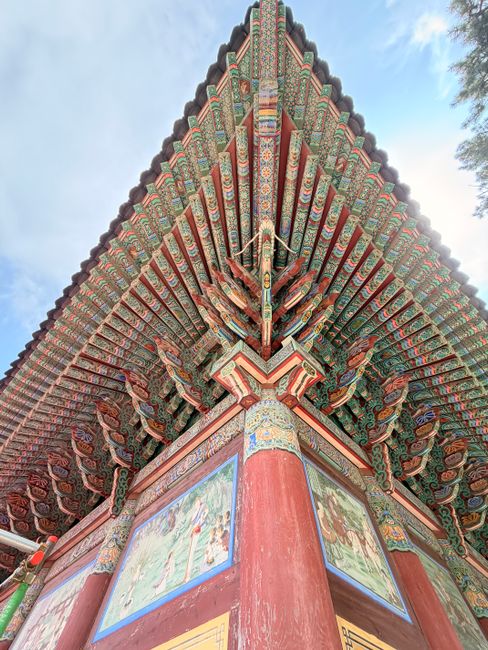
Gyeongju (경주): The City That Is Itself a Museum
Walk ten minutes in any direction from Gyeongju’s city center and you will pass a burial mound. Not a replica. Not a reconstruction. An actual royal tomb from the Silla Kingdom (57 BCE–935 CE), grass-covered and silent, sitting between a convenience store and a parking lot. That collision of eras is the whole experience.
The Historic Areas of Gyeongju were inscribed on the UNESCO World Heritage List in 2000. The designation covers five zones: the Namsan (남산) mountain belt, the Wolseong (월성) palace district, the Daereungwon (대릉원) tumuli park, Hwangnyongsa (황룡사) temple site, and the Sanseong (산성) fortress belt. Each zone demands at least half a day to absorb properly.
Daereungwon alone contains 23 burial mounds within a single park. Cheonmachong (천마총) — the “Heavenly Horse Tomb” — is open from the inside. You walk into a reconstructed burial chamber and stand roughly where a Silla king was interred sometime in the 5th century CE. The gold crown on display inside is not a copy. It weighs 293 grams and was found exactly where it now sits.
The gold crown of Cheonmachong wasn’t locked in a vault. It was buried with a king for 1,500 years, then left in the tomb where it was found. That is either extraordinary confidence or extraordinary indifference. Either way, it works.
Bulguksa (불국사) temple, 16 kilometers east of central Gyeongju, is the architectural anchor of the site. Built in 528 CE and reconstructed repeatedly through the Joseon Dynasty, it holds two stone pagodas — Dabotap (다보탑) and Seokgatap (석가탑) — that represent the pinnacle of Unified Silla stone craftsmanship. Seokgatap’s proportions have been studied by architects for centuries. Nothing about it is accidental.
📍 Daereungwon Tumuli Park (대릉원)
- Address: 9 Gyerim-ro, Gyeongju-si, Gyeongsangbuk-do
- Hours: 09:00–22:00 (last entry 21:30)
- Admission: Adults 3,000 KRW
- Getting there: From Gyeongju Station (KTX), take Bus 10 or 11 to the Gyerim-ro stop (approx. 15 min)
- Official site: https://www.gyeongju.go.kr
📍 Bulguksa Temple (불국사)
- Address: 385 Bulguk-ro, Gyeongju-si, Gyeongsangbuk-do
- Hours: 07:00–18:00 (seasonal variation applies)
- Admission: Adults 6,000 KRW
- Getting there: From Gyeongju Station, take Bus 10 or 11 to the Bulguksa stop (approx. 40 min)
- Official site: https://www.bulguksa.or.kr
Haeinsa Temple and the Tripitaka Koreana (해인사): 81,258 Wooden Blocks and Zero Decay
In the 13th century, with the Mongol army burning its way across the Korean peninsula, a group of Buddhist monks spent 16 years carving the entire Buddhist canon onto 81,258 wooden printing blocks. The project was not a backup plan. It was an act of civilizational defiance — the conviction that if the texts survived, something essential would survive with them.
Those blocks still exist. They are stored at Haeinsa Temple (해인사) on Mount Gayasan (가야산) in South Gyeongsang Province, in wooden storage halls built in the 15th century specifically for their preservation. The halls — known as Janggyeong Panjeon (장경판전) — were inscribed as a UNESCO World Heritage Site in 1995. The Tripitaka Koreana itself received separate inscription in 2007 as a UNESCO Memory of the World document.
The storage halls have no heating, no air conditioning, and no dehumidifiers. They function through a system of precisely calibrated ventilation — window sizes, floor composition, and orientation relative to prevailing winds — that has kept the blocks in stable condition for over 600 years. Modern conservators have studied the halls and concluded that replicating the system with contemporary materials would likely perform worse. The 15th-century architects understood something that took centuries to rediscover.
The blocks themselves cannot be touched. Visitors walk the outer corridors and view them through wooden lattice. That distance is not a loss — it is the correct relationship to have with something 800 years old.
📍 Haeinsa Temple (해인사)
- Address: 122 Haeinsa-gil, Gayasan-myeon, Hapcheon-gun, Gyeongsangnam-do
- Hours: 08:30–18:00
- Admission: Adults 3,000 KRW
- Getting there: From Daegu Seobu Intercity Bus Terminal, take a direct bus to Haeinsa (approx. 1 hr 20 min)
- Official site: https://www.haeinsa.or.kr
Hwaseong Fortress (수원화성): The King Who Built a City to Prove a Point
King Jeongjo of Joseon didn’t build Hwaseong Fortress (수원화성) for defense. He built it to relocate the capital — or at least to make a credible threat of it. The fortress city, constructed between 1794 and 1796, was designed by scholar Jeong Yakyong (정약용) using a combination of traditional Korean construction methods and newly translated Chinese and Western engineering texts. It was the first Korean fortification to incorporate both brick and stone in a systematic way, and the result enclosed 5.7 kilometers of walls around a city built from scratch in under three years.
Hwaseong was inscribed as a UNESCO World Heritage Site in 1997. Unlike many heritage sites, it is not a ruin. The walls were damaged during the Korean War but reconstructed in the 1970s using the original construction manual — the Hwaseong Seongyeok Uigwe (화성성역의궤) — which recorded every material, every worker, and every design decision made during the original build. That document is precisely why the reconstruction is considered authentic rather than speculative.
The fortress perimeter can be walked in full in approximately three hours. The Hwahongmun (화홍문) sluice gate — seven arches spanning a stream at the northern wall — is the most photographed element. It looks best in early morning, before the tour groups arrive. That is not a suggestion. That is a fact about light and crowds.
📍 Hwaseong Fortress (수원화성)
- Address: Hwaseong-ro, Paldal-gu, Suwon-si, Gyeonggi-do
- Hours: 09:00–18:00 (Paldalmun gate area accessible 24 hours)
- Admission: Adults 1,000 KRW (fortress wall access)
- Getting there: From Seoul, take subway Line 1 to Suwon Station, then Bus 11 or 13 to Hwaseong (approx. 15 min from the station)
- Official site: https://www.swcf.or.kr

Jongmyo Shrine (종묘): The Longest Ritual in Korean History Is Still Running
Jongmyo (종묘) is a Confucian royal shrine in central Seoul that houses the spirit tablets of Joseon Dynasty kings and queens. It was built in 1395 — just three years after the dynasty itself was founded — and has been in continuous ritual use for over 600 years. The Jongmyo Jerye (종묘제례), the royal ancestral rite performed here, was inscribed on UNESCO’s Intangible Cultural Heritage list in 2001. The rite is still performed annually in May, with full ceremonial costume and the original ritual music.
The architecture is deliberately austere. Long, low wooden halls — the Jeongjeon (정전) main hall stretches 109 meters, making it one of the longest wooden structures in East Asia — face a stone courtyard designed to amplify silence. There is no ornamentation for its own sake. Every element is calibrated to produce a specific psychological state: an awareness of time, an obligation to the dead, and the weight of continuity.
UNESCO inscribed Jongmyo as a World Heritage Site in 1995. It sits ten minutes on foot from Gyeongbokgung Palace (경복궁), yet most visitors never make the connection. The two sites are architecturally and historically inseparable — one was where the king governed the living; the other was where he governed his relationship with the dead.
📍 Jongmyo Shrine (종묘)
- Address: 157 Jong-ro, Jongno-gu, Seoul
- Hours: 09:00–18:00 (Wed–Mon; closed Tuesday). Guided tours required on most days.
- Admission: Adults 1,000 KRW
- Getting there: Jongno 3-ga Station (Lines 1, 3, 5), Exit 11 — 5-minute walk
- Official site: https://jm.cha.go.kr
The Practical Reality: What No One Tells You Before You Go
Here is the scenario. You arrive at Haeinsa Temple in August. The mountain road is single-lane. The last bus back to Daegu left at 17:30. You didn’t know there was a last bus because the English signage at the bus stop listed departure times without specifying direction. You are now stranded on a mountain with a dead phone and no Korean.
This is not hypothetical. It happens to multiple foreign visitors every summer.
The fix is straightforward: download the Naver Maps (네이버 지도) app before you leave Seoul and set it to English. It pulls real-time bus schedules, including last-departure times. For heritage sites outside major cities — Haeinsa, Bulguksa, the Royal Tombs of the Joseon Dynasty (조선왕릉) — always check the last return departure before you enter the site, not after. These places are designed to make you lose track of time. They succeed.
For medical emergencies at remote heritage sites: the Korea Tourism Organization operates a 24-hour tourist helpline at 1330 (dial directly from any Korean phone or SIM; international callers can prefix with +82-2-1330). English, Japanese, and Chinese operators are available around the clock. Save the number before you leave your accommodation. When planning your trip, book tours in advance to secure guides and transportation, and make sure you stay connected with a local eSIM for navigation and emergencies.
The Joseon Royal Tombs (조선왕릉): 40 Tombs, 500 Years, One Unbroken Line
The Royal Tombs of the Joseon Dynasty received UNESCO inscription in 2009. The designation covers 40 tombs spread across 18 locations in and around Seoul and Gyeonggi Province. Every Joseon monarch — all 27 of them, along with queens and royal consorts — is represented. The dynastic line ran from 1392 to 1910: 518 years of unbroken royal burial tradition held to a single standard of ceremonial architecture.
Donggureung (동구릉) in Guri City, east of Seoul, is the largest cluster — nine tombs across a forested site that takes roughly two hours to walk in full. The approach paths are lined with stone animal and human figures standing guard. In winter, when the site is nearly empty and the pine trees carry snow, the atmosphere is not peaceful. It is something older than peaceful.
📍 Donggureung Royal Tomb Cluster (동구릉)
- Address: 197 Donggu-reung-ro, Inchang-dong, Guri-si, Gyeonggi-do
- Hours: 09:00–18:00 (Feb–May, Sep–Oct); 09:00–18:30 (Jun–Aug); 09:00–17:30 (Nov–Jan). Closed Mondays.
- Admission: Adults 1,000 KRW
- Getting there: From Guui Station (Line 2), take Bus 88 or 1-1 to Donggureung (approx. 20 min)
- Official site: https://royaltombs.cha.go.kr
Rover’s Take
Korea spent centuries building things meant to outlast empires — and then spent the 20th century nearly losing all of it. The fact that 16 UNESCO sites survived is not a triumph of heritage policy. It is a narrow escape dressed up as a cultural itinerary.