
There are 40 royal tombs scattered across the Seoul metropolitan area, and 36 of them are still standing exactly where they were built — some over 600 years ago. No fences were torn down. No roads cut through them. The Joseon dynasty (조선왕조) simply decided that these grounds were untouchable, and that decision held.
In 2009, UNESCO agreed. The Royal Tombs of Joseon (조선왕릉) were inscribed as a World Heritage Site — 40 tombs, 18 sites, spread across the modern cities of Seoul, Gyeonggi Province, and even one in North Korea. That last one you can’t visit. The other 39 are open to the public, and most foreigners have never heard of a single one.
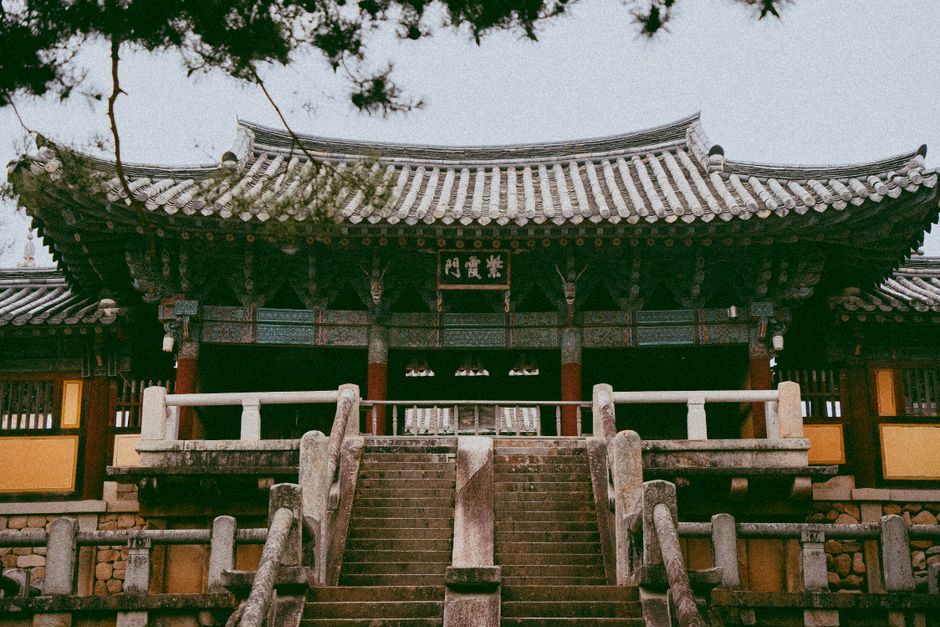
Why 500 Years of Kings Chose the Same Blueprint
Every Joseon royal tomb follows a nearly identical spatial logic. Walk through the entrance gate and the geometry starts immediately: a straight stone path called the Chambered Way (신도) runs from the outer gate to the burial mound. It’s slightly elevated. You don’t walk on it. That path belongs to the spirit of the deceased king, and this rule was enforced for five centuries without interruption.
The tomb complex is divided into three distinct zones. The outer zone is where commoners and visitors gathered. The middle zone holds the ritual pavilion (정자각) — a T-shaped hall where ancestral rites were performed twice a year. The inner zone, elevated on a hillside, is the burial mound itself, ringed by stone figures of civil officials, military officers, horses, and mythical animals. These stone guardians (석물) weren’t decorative. They were the permanent security detail for eternity.
What makes this remarkable is the consistency. The Joseon dynasty lasted from 1392 to 1897 — 505 years, 27 kings. Every single royal tomb built during that span followed this same ritual geography. No other ruling dynasty in the world maintained such architectural continuity across that many generations.
The Three Tombs Every First-Time Visitor Should Know
Donggureung (동구릉): Nine Tombs, One Forest
Donggureung in Guri City, Gyeonggi Province, is the largest royal tomb cluster in Korea — nine individual tombs spread across a single forested complex covering roughly 1.97 square kilometers. The first tomb here was built in 1408 for King Taejo (태조), the founder of the Joseon dynasty. Eight more followed over the next 450 years. Walking the full circuit takes about 90 minutes at a relaxed pace, and the pine forest surrounding the mounds is dense enough that summer temperatures inside the complex run 3–4°C cooler than the roads outside.
For foreign visitors, Donggureung solves a logistical problem: instead of driving between five different sites to understand the tomb typology, you can see the full range of variation — early Joseon restraint, mid-period elaboration, late-period grandeur — within a single admission ticket. The path between tombs is flat and paved. It works in dress shoes.
📍 Donggureung Royal Tomb Cluster (동구릉)
- Address: 197 Injangsan-ro, Inchang-dong, Guri-si, Gyeonggi-do
- Hours: 9:00 AM – 6:30 PM (Feb–May, Sep–Oct); 9:00 AM – 6:30 PM (Jun–Aug closes at 6:30 PM); closed Mondays
- Admission: Adults ₩1,000; ages 6–18 ₩500; under 6 and over 64 free
- Getting there: Donggureung Bus Stop — take Bus 1-1 or 1-4 from Gupabal Station (Line 3), or direct bus from Sangbong Station (Line 7)
- Official site: https://royaltombs.cha.go.kr
Seooreung (서오릉): Five Tombs, Zero Crowds
Five kilometers northwest of central Seoul, Seooreung holds five royal tombs and consistently draws a fraction of the visitors that Gyeongbokgung Palace (경복궁) handles on any given weekend. The complex includes the tomb of Queen Jangryeol, the tomb of King Sukjong — the same king at the center of the Jang Ok-jeong (장옥정) historical drama — and the tomb of Crown Prince Uiso, who died at age 3 and whose mound is noticeably smaller than the others. That scale difference is not accidental. Joseon tomb architecture encoded rank, age, and circumstance into every dimension.
The surrounding woodland here is old-growth by Korean urban standards — trees that predate the Korean War, undisturbed because the grounds were sealed for centuries. In autumn (late October to mid-November), the ginkgo and maple canopy over the stone paths turns the complex into something that no tour operator has adequately photographed yet.
📍 Seooreung Royal Tomb Complex (서오릉)
- Address: 334-32 Seooreung-ro, Yongdu-dong, Deogyang-gu, Goyang-si, Gyeonggi-do
- Hours: 9:00 AM – 6:30 PM (seasonal variation); closed Mondays
- Admission: Adults ₩1,000; reduced rates for youth and seniors
- Getting there: Bus from Neunggok Station (Gyeongui-Jungang Line), approximately 10 minutes
- Official site: https://royaltombs.cha.go.kr

Taereung and Gangneung (태릉·강릉): The Warrior Queen’s Tomb
Taereung, in northeastern Seoul’s Nowon District, is the tomb of Queen Munjeong — a woman who ruled Joseon as regent for eight years in the mid-16th century and wielded more actual political power than most kings who got their own tombs. The stone figures at Taereung are considered among the finest in the entire Joseon tomb canon: the civil official statues have individualized facial expressions, which is unusual. Most tomb figures are deliberately generic. These are not.
Adjacent Gangneung is the double tomb of King Myeongjong and his queen. The two complexes are managed together and sit within what used to be the grounds of the Korea Army Athletics Corps — which explains why the surrounding area still has the feel of a military installation rather than a tourist district. That’s not a complaint. The absence of souvenir stalls is part of what makes it work.
📍 Taereung and Gangneung (태릉·강릉)
- Address: 681 Hwarang-ro, Gongneung-dong, Nowon-gu, Seoul
- Hours: 9:00 AM – 6:30 PM (seasonal variation); closed Mondays
- Admission: Adults ₩1,000
- Getting there: Taereung Station (Line 6 / Gyeongchun Line), Exit 2, approximately 10-minute walk
- Official site: https://royaltombs.cha.go.kr
The Language Barrier Scenario Most Guides Skip
You’re at Donggureung. Your phone battery is at 4%. The last bus back to Sangbong Station left 11 minutes ago and you didn’t know there was a last bus. The ticket office is closed. There is one staff member near the entrance gate, and he speaks no English.
This is not hypothetical. It happens, specifically at the outer tomb clusters, where public transit frequency drops sharply after 5:00 PM on weekdays and even earlier on weekends in winter. The fix is simple but requires knowing in advance: save the Korean text “상봉역 가는 버스 어디서 타요?” (Where do I catch the bus to Sangbong Station?) in your phone’s notes app before you go. Show it to any local. Response rate is close to 100%. Alternatively, stay connected with a Korean eSIM and use Kakao Taxi, which operates in Guri City and auto-detects English in its interface. A ride from Donggureung to Sangbong Station runs approximately ₩8,000–₩12,000 depending on traffic.
The other scenario worth flagging: tomb complexes have almost no food vendors inside the grounds. Cultural heritage protection rules prohibit commercial activity within the buffer zones. Bring water. Bring a snack. The nearest convenience store to Donggureung is a 12-minute walk from the main gate. Plan accordingly.
What the Stone Animals Are Actually Guarding
The stone figures arranged around each burial mound follow a prescribed hierarchy that Joseon court officials debated for decades before standardizing. Closest to the mound: stone sheep and tigers, representing gentleness and ferocity — the two qualities a ruler needed in balance. Further out: stone horses and their grooms. At the perimeter: the civil and military officials, facing the mound in permanent attendance.
The craftsmanship varies dramatically across the 500-year production run. Early Joseon figures (late 14th to 15th century) are blocky, almost abstract — power communicated through mass rather than detail. Mid-Joseon figures (16th to 17th century) grow more naturalistic. Late Joseon figures sometimes look almost portrait-like. Walking the tombs in chronological order is, effectively, a survey of Korean sculptural history that no museum has managed to replicate under a single roof.
The burial mound itself — the grass-covered hemisphere at the center of each tomb — sits over a stone chamber built to last indefinitely. Joseon engineers lined the chambers with multiple layers of lime plaster specifically to prevent moisture intrusion. Most of those chambers have never been excavated. The contents remain sealed.

Practical Logistics for a Full-Day Tomb Circuit
A realistic one-day itinerary for a foreign visitor using public transit: start at Taereung and Gangneung (open from 9:00 AM, 30 minutes from central Seoul on Line 6), spend 90 minutes, then book tours in advance or take a taxi or bus to Donggureung in Guri — approximately 25 minutes by car, ₩15,000–₩20,000 by taxi. Spend 2–2.5 hours at Donggureung. Return to Seoul via Sangbong Station. Total admission for both sites: ₩2,000. Total walking distance: approximately 6 kilometers. The entire circuit is manageable without a tour guide, but the Cultural Heritage Administration (문화재청) offers free English-language audio guides via QR code at the entrance of most major sites as of 2023.
Spring (late March to early April) and autumn (late October to early November) are the optimal seasons. Summer works if you start before 10:00 AM — the forest canopy keeps the tomb paths cooler than open-air attractions, but humidity above 80% makes the stone paths slick. Winter visits are underrated: bare trees expose the full geometry of the mound landscaping in a way that foliage conceals, and weekday crowds in January drop to near zero.
Rover’s Take
Six hundred years of unbroken ritual geography, still intact inside one of the most densely developed metropolitan areas on earth — and the average Seoul tourist spends their afternoon in line for a palace photo that every travel account already has.