
Seoul splits itself in half — and both halves will fight you on which one is worth your day.
The Han River (한강) runs through the middle of the city like a referee nobody listens to. North of it: palaces, alleyways, street food markets that have been running since before your country had a subway system. South of it: glass towers, curated coffee shops, the kind of streets that look like they were designed to be photographed. One day. Two completely different cities. The choice is not obvious.
This is not a list of “must-see” spots. This is a route — tested against real conditions, real crowds, real transit delays — so you can move through Seoul like someone who has been here before, even if you haven’t.
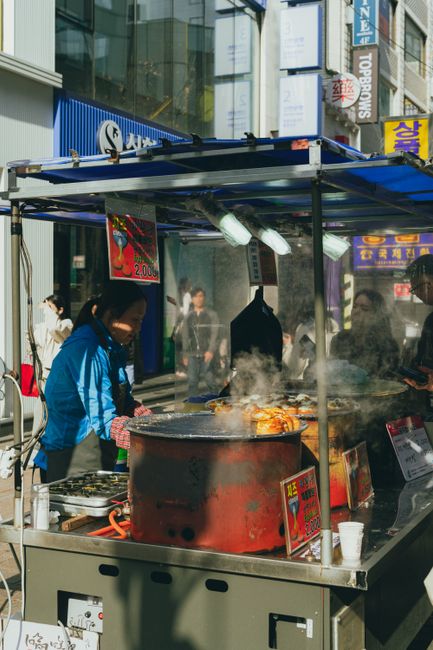
Gangbuk (강북): The North Route — Where Seoul Remembers Itself
Start at 8:00 AM. The city hasn’t fully woken up yet, and that gap is yours to use.
Gyeongbokgung at opening hour beats Gyeongbokgung at noon by a margin that will physically surprise you
Gyeongbokgung Palace (경복궁) opens at 9:00 AM. Arrive by 8:45. The line at opening is manageable — roughly 20 to 40 people on a weekday morning, compared to the 200-plus queue that forms by 10:30 AM on weekends, particularly during peak autumn and spring seasons. The palace compound covers 410,000 square meters. You will not see all of it. Pick the central axis — Gwanghwamun Gate to Geunjeongjeon Hall to Hyangwonjeong Pavilion — and walk it slowly. That takes 90 minutes. Everything else is bonus.
Hanbok (한복) rental is available at multiple stalls just outside the Gyeonghamun Gate entrance. Rental runs approximately 10,000 to 30,000 KRW for a 2-to-4-hour window depending on the vendor and costume tier. Hanbok wearers enter the palace free of charge. That is not a tourist gimmick — it is official policy from the Cultural Heritage Administration of Korea.
The palace was burned twice. Rebuilt twice. The third version standing today dates to an 1867 reconstruction ordered by Regent Heungseon Daewongun — a man who poured the equivalent of a small national treasury into stone and wood while the country was already fracturing at its edges.
📍 Gyeongbokgung Palace
- Address: 161 Sajik-ro, Jongno-gu, Seoul
- Hours: 9:00 AM – 6:00 PM (March–October); 9:00 AM – 5:00 PM (November–February); closed Tuesdays
- Admission: 3,000 KRW (adults); free for hanbok wearers
- Getting there: Gyeongbokgung Station (경복궁역), Line 3, Exit 5
- Official site: https://www.royalpalace.go.kr
Bukchon is not a photo backdrop — it is 600 years of compressed real estate
Walk northeast from the palace. Bukchon Hanok Village (북촌 한옥마을) is a 15-minute walk from Gyeongbokgung’s eastern wall. The neighborhood contains approximately 900 traditional hanok structures — private residences, guesthouses, small galleries — packed into a hillside grid between two royal palaces. People live here. That is the part most visitors miss. Noise complaints from residents have been formally documented by Jongno-gu district office since at least 2016, and signage throughout the village now requests silence before 10:00 AM and after 5:00 PM.
The most photographed angle is at Bukchon-ro 11-gil — a steep alley that curves downward with tiled rooftops stacking into the frame. Arrive before 10:00 AM or after 4:30 PM. Midday crowds on that particular alley can reach shoulder-to-shoulder density during cherry blossom season (late March to mid-April) and autumn foliage season (late October to early November).
📍 Bukchon Hanok Village
- Address: Gyedong-gil, Jongno-gu, Seoul (main entrance area)
- Hours: Open area; no set hours. Quiet hours requested before 10:00 AM and after 5:00 PM
- Admission: Free
- Getting there: Anguk Station (안국역), Line 3, Exit 2 — 5-minute walk
- Official site: https://bukchon.seoul.go.kr
Lunch does not require a restaurant when Gwangjang is open
Gwangjang Market (광장시장) is a 12-minute walk south from Bukchon, or a single stop on Line 1 from Jonggak Station to Jongno 5-ga Station. The market has operated continuously since 1905 — making it one of the oldest traditional markets in Korea still functioning under its original purpose. The textile section occupies the upper floors. The food alley runs through the basement and ground-level interior, and it is where you eat.
Bindaetteok (빈대떡) — mung bean pancakes — are fried to order at stalls that have been in the same family for two and three generations. The oil hisses, the edges crisp dark gold, and the smell hits you from halfway down the alley. A single large pancake runs 4,000 to 5,000 KRW. Mayak gimbap (마약김밥) — literally “narcotic rice rolls,” named for their addictive quality, not their contents — is sold in portions of 10 small rolls for approximately 3,000 KRW. Eat standing at the stall counter. That is not a suggestion about atmosphere. It is how the space is physically designed.
📍 Gwangjang Market
- Address: 88 Changgyeonggung-ro, Jongno-gu, Seoul
- Hours: 9:00 AM – 11:00 PM (most food stalls); some vendors close earlier
- Admission: Free
- Getting there: Jongno 5-ga Station (종로5가역), Line 1, Exit 8
- Official site: https://www.gwangjangmarket.co.kr
Gangnam (강남): The South Route — Where Seoul Performs Itself
Cross the river after 1:00 PM. The south side runs later and brighter.
Coex is not a mall — it is an underground city with a library inside it
Coex Mall (코엑스몰) in Samseong-dong is one of the largest underground shopping complexes in Asia, with a total floor area exceeding 160,000 square meters as of its 2014 renovation expansion. The Starfield Library (별마당 도서관) inside Coex — a publicly accessible, open-plan library installed in 2017 — has become one of the most photographed interior spaces in Seoul. Two 13-meter-tall bookshelves anchor the central atrium. Entry is free. No library card required. No purchase required.
The surrounding Gangnam district draws an estimated 20 million visitors annually, according to Seoul Metropolitan Government figures from 2023. The streets above Coex — particularly Teheran-ro (테헤란로) and Apgujeong Rodeo Street (압구정 로데오) — represent the commercial face of South Korean cultural export: flagship K-beauty stores, entertainment company buildings, high-end Korean fashion labels. It reads as aspirational and deliberate in equal measure.
📍 Coex Mall / Starfield Library
- Address: 513 Yeongdong-daero, Gangnam-gu, Seoul
- Hours: Mall: 10:30 AM – 10:00 PM; Starfield Library: 10:30 AM – 10:00 PM
- Admission: Free (library); shopping mall access free
- Getting there: Samseong Station (삼성역), Line 2, Exit 6
- Official site: https://www.coexmall.com
Garosu-gil is one tree-lined street that somehow became a cultural argument
Garosu-gil (가로수길) — literally “tree-lined street” — runs for roughly 700 meters through Sinsa-dong (신사동). It became Seoul’s first designated “boutique street” in the early 2000s, drawing independent designers and small gallery owners priced out of Insadong (인사동) to the north. By 2015, rising rents had pushed most of those original tenants out, replaced by global brands and chain cafes. What remained is a curated version of what the street once was — still visually coherent, still worth walking, but honest about what it has become.
The side streets branching off Garosu-gil — locally called Serosu-gil (세로수길) — still hold smaller, independently operated spaces. That is where the original energy relocated. The main strip is for the photograph. The side streets are for the actual experience.
📍 Garosu-gil
- Address: Garosu-gil, Sinsa-dong, Gangnam-gu, Seoul
- Hours: Outdoor street; no set hours. Most shops open 11:00 AM – 10:00 PM
- Admission: Free
- Getting there: Sinnonhyeon Station (신논현역), Line 9, Exit 1 — 5-minute walk; or Apgujeong Station (압구정역), Line 3, Exit 5
- Official site: N/A
Bongeunsa at dusk is the one moment Gangnam stops pretending
Bongeunsa Temple (봉은사) sits directly across from the Coex complex — a 1,200-year-old Buddhist temple pressed against the glass towers of one of Asia’s most expensive real estate corridors. The contrast is not subtle. It is the visual thesis of modern Seoul stated in a single frame. The temple grounds are open until 11:00 PM. Evening hours after 6:00 PM draw far fewer visitors than daytime. The main hall, Daeungjeon (대웅전), contains a seated Buddha flanked by painted murals dating to the Joseon period — the incense smoke curling up toward the ceiling in the kind of slow drift that makes you stand still without deciding to.
Temple Stay programs — overnight meditation and ritual experiences — are available through the temple’s official booking system, with prices starting around 70,000 KRW per person. Advance reservation is required and slots fill weeks ahead during spring and autumn.
📍 Bongeunsa Temple
- Address: 531 Bongeunsa-ro, Gangnam-gu, Seoul
- Hours: Open daily, 24 hours (main grounds); administrative offices have limited hours
- Admission: Free
- Getting there: Bongeunsa Station (봉은사역), Line 9, Exit 1
- Official site: https://www.bongeunsa.org
The Scenario Nobody Puts in the Itinerary
You are in Bukchon at 3:00 PM. Your phone dies. You need to get to Gangnam by 6:00 PM for a dinner reservation. You do not speak Korean. The nearest convenience store — GS25, CU, 7-Eleven, all of which exist within 200 meters of almost any point in central Seoul — will have a USB charging cable for sale at approximately 8,000 to 15,000 KRW. Every convenience store also has a staff member who, even with zero shared language, will point at a subway map if you show them a destination name written in any script. Write “Gangnam” on your phone screen. Show it. The pointing will follow.
Seoul’s subway system covers 23 lines and over 340 stations as of 2024. The T-money card (티머니 카드) — a rechargeable transit card sold at all subway station vending machines and convenience stores for 4,000 KRW (card fee) plus whatever balance you load — works across subway, bus, and some taxis. Lost it? Report to the nearest station’s customer service window. The card’s balance is not recoverable without the card number, but the card itself costs less than a cup of coffee in Gangnam. Replace it. Move on.
Gangbuk vs. Gangnam: The Actual Difference
Gangbuk gives you Seoul’s memory. Gangnam gives you Seoul’s ambition. Neither is more authentic — that framing is a trap tourists set for themselves. The palace was rebuilt by political calculation. The temple survived by negotiating with developers. The market stalls in Gwangjang have adjusted their menus based on what foreign visitors order most. Every “authentic” thing in a living city is also a negotiation with the present.
One day is enough to understand the argument. It is not enough to settle it. Before you leave Seoul, stay connected with a Korean eSIM so you can move seamlessly between both sides of the city.
Rover’s Take
Seoul doesn’t need you to choose a side — it needs you to notice that the river running between them has been there longer than either version of the city built on its banks.