
It’s past 11 p.m. and the line hasn’t moved in twenty minutes. Nobody cares. The smell of charcoal and sesame oil has everyone rooted to the spot, and the vendor — a woman in her sixties who has been doing this since before smartphones existed — doesn’t even look up. This is Seoul after dark, and it runs on its own clock.
Seoul’s night markets are not a tourism product. They are a pressure valve. In a city where the average worker logs over 1,900 hours per year (OECD, 2023 data — roughly 200 hours more than the European average), the streets don’t empty at night. They transform. What foreigners call a “night market,” locals call Tuesday.
The Map Nobody Hands You at the Airport
Seoul has no single night market district. It has layers. Each neighborhood operates on a different frequency, and showing up at the wrong one for the wrong reasons is the fastest way to feel like a tourist in the worst sense of the word. The three anchors — Gwangjang Market (광장시장), Dongdaemun (동대문), and Mangwon Market (망원시장) — are not interchangeable. They are three different cities folded inside one.
Gwangjang Market is the oldest continuously operating market in Korea, established in 1905. The raw numbers are almost absurd: over 5,000 vendors, a covered arcade stretching several city blocks, and a food alley running at full capacity from early morning until well past midnight. The signature item is mayak gimbap (마약김밥) — thumb-sized rice rolls so addictive the name literally translates to “narcotic gimbap.” A single serving costs around 3,000 won (approximately $2.20 USD as of 2025). The bindaetteok (빈대떡), a mung bean pancake fried in lard on a flat iron griddle, runs about 4,000 won and pairs with makgeolli (막걸리) — unfiltered rice wine served in a brass bowl — for another 3,000. You will spend less than ten dollars and feel like you owe someone an apology for how good it was.
📍 Gwangjang Market (광장시장)
- Address: 88 Changgyeonggung-ro, Jongno-gu, Seoul
- Hours: Daily 09:00–23:00 (food alley vendors often run until midnight or later)
- Admission: Free
- Getting there: Seoul Subway Line 1 or 5 — Jongno 5-ga Station, Exit 8
- Official site: http://www.kwangjangmarket.co.kr
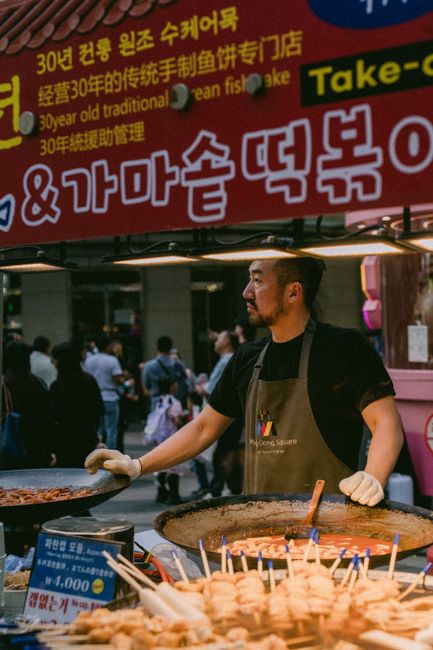
Dongdaemun operates on an entirely different logic. The fashion wholesale district surrounding Dongdaemun Design Plaza (동대문디자인플라자) doesn’t fully wake up until midnight. By 2 a.m., the streets are gridlocked with buyers from across Asia loading fabric bolts into vans. The food stalls here cater to people with no intention of sleeping — tteokbokki (떡볶이) carts, eomuk (어묵) fish cake skewers bobbing in hot broth, and pojangmacha (포장마차) tents serving sundae (순대), a Korean blood sausage stuffed with glass noodles. The pojangmacha tent is one of the last truly democratic spaces in Seoul. Stockbrokers and delivery drivers eat at the same plastic table.
📍 Dongdaemun Design Plaza (동대문디자인플라자)
- Address: 281 Eulji-ro, Jung-gu, Seoul
- Hours: Plaza open 24 hours; individual shops and stalls vary
- Admission: Free (plaza access)
- Getting there: Seoul Subway Line 2, 4, or 5 — Dongdaemun History & Culture Park Station, Exit 1
- Official site: https://www.ddp.or.kr

Mangwon: The Version Locals Actually Prefer
Mangwon Market sits in Mapo-gu, across the river from the tourist corridors. It doesn’t appear in most airport brochures. That is precisely the point. The Saturday market at Mangwon is a weekend institution for the Hongdae (홍대) and Yeonnam-dong (연남동) residential crowd — younger, local, and deeply uninterested in performing authenticity for cameras. Stalls here sell hotteok (호떡) filled with brown sugar and seeds, gyeran-ppang (계란빵) — a soft bread baked around a whole egg — and seasonal items that change without announcement. Nobody posts a menu in English. That is not hostility. That is simply how it works.
The market runs along a narrow indoor arcade and spills into the surrounding streets on weekends. Prices are, by Seoul standards, aggressively reasonable. A full meal assembled from three or four stalls will cost under 10,000 won (approximately $7.30 USD, 2025 exchange rate). The crowd peaks between 6 p.m. and 9 p.m. After that, the serious eaters arrive.
📍 Mangwon Market (망원시장)
- Address: 10 Poeun-ro, Mapo-gu, Seoul
- Hours: Daily approximately 09:00–22:00; weekend evening stalls often run later
- Admission: Free
- Getting there: Seoul Subway Line 6 — Mangwon Station, Exit 2 (approximately 5-minute walk)
- Official site: https://www.mangwonmarket.co.kr
The Scenario Nobody Warns You About
It’s 1:30 a.m. You’ve eaten more than you planned, the makgeolli hit harder than expected, and your phone is at 4%. The last subway train left at midnight. This is not a hypothetical. It is the standard Tuesday night outcome for anyone who takes Seoul’s night food culture seriously.
Taxis in Seoul are plentiful, but the app matters. KakaoTaxi (카카오택시) is the dominant platform — it functions in English, accepts foreign credit cards linked through KakaoPay, and displays a fixed fare estimate before you confirm. Standard taxis carry a late-night surcharge of 20% between midnight and 4 a.m. (Seoul Metropolitan Government, 2024). Black KakaoTaxi runs on a premium rate but offers an English-capable driver option. If your phone is dead, convenience stores — CU (씨유), GS25, 7-Eleven — are open 24 hours and will let you charge at the counter if you ask. The phrase “haendeupon chungjeonssi isseoyo?” (핸드폰 충전 시 있어요?) will get the point across. Most staff at convenience stores near tourist corridors understand basic English gestures even without the words. You can also stay connected with a local eSIM to ensure reliable data while navigating the city.
One harder scenario: if you lose a wallet or bag at a market, go directly to the nearest police box (jipso, 지구대). Seoul has a remarkably high lost-and-found return rate — the Seoul Metropolitan Police Agency reported in 2023 that over 80% of items registered at police boxes were recovered. Markets like Gwangjang have informal lost-and-found arrangements through the vendor association office near the main entrance. Ask any vendor. Point. They will understand.
What “Eating Like a Local” Actually Means Here
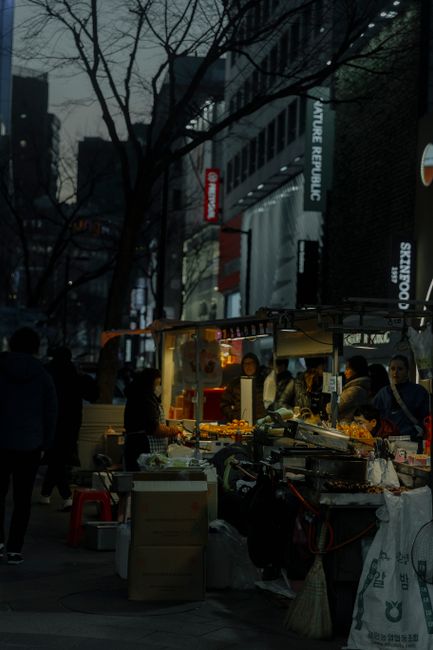
It does not mean ordering the most extreme item on the menu. It means standing at a counter, eating quickly, not complaining about the plastic stool, and leaving when you’re done without lingering for a photo opportunity. It means understanding that the vendor’s job is to feed people — not to curate your travel memory.
“The best meals in Seoul happen between midnight and 2 a.m., cost less than a subway fare in Tokyo, and are eaten standing up in the rain.”
The night food culture of Seoul is not picturesque in the way travel content suggests. It is loud, efficient, slightly chaotic, and completely indifferent to your presence. That indifference is the thing you will miss most when you leave. It means you were actually there — not in a simulation of the place, but in the place itself. You can book tours in advance to explore these markets with local guides if you prefer a more structured experience.
In 2026, several of the pojangmacha tents around Dongdaemun face municipal pressure over licensing and hygiene compliance upgrades — a recurring cycle that has reshaped Seoul street food every decade since the 1980s. Some will relocate. Some will close. The food itself will survive in a different form, as it always has. Seoul street food has outlasted every attempt to formalize it. It is not sentimental about its own continuity. It just keeps cooking.
Rover’s Take
The best night market guide Seoul will ever produce is the one you write yourself at 1 a.m., grease on your sleeve, trying to remember which alley had the better bindaetteok — and the fact that you can’t remember means both were worth it.