
Midnight in Seoul. The city doesn’t slow down — it shifts gears. Streets that emptied of office workers fill back up with something rawer, louder, and far more honest about what people actually want after dark.
Seoul’s night markets are not tourist attractions dressed up as culture. They are culture — the kind that runs on hunger, habit, and the particular freedom that comes after 10 p.m. For foreign visitors, stepping into one for the first time is less like sightseeing and more like accidentally walking into someone’s living room. Crowded, warm, slightly chaotic, and impossible to leave quickly.
The Numbers That Tell You Everything
Seoul operates on a schedule that would exhaust most cities. The metropolitan area holds roughly 9.7 million residents within the city limits alone (Statistics Korea, 2023), and a significant portion of them eat their most satisfying meal after sunset. Street food vendors in major markets collectively serve hundreds of thousands of customers on peak weekend nights. Gwangjang Market (광장시장), one of the oldest continuously operating traditional markets in Korea, was founded in 1905 — making it older than most countries’ national airline carriers.
That longevity is not accidental. It is the product of a food culture that treats the street as a legitimate dining room. Not a fallback. Not a budget compromise. A preference.
Three Words That Define Seoul After Dark: Desperation, Trial, Inspiration
Every vendor at every stall carries a version of the same story. Desperation first — the kind that comes from limited options, from needing to feed a family with minimal capital, from a postwar economy (Korea’s reconstruction era through the 1950s and 60s) that pushed resourcefulness into every corner of daily life. The original pojangmacha (포장마차) — canvas-covered street stalls — emerged directly from that era. People sold what they had. They cooked what they could afford.
Then came trial. Recipes refined over decades. A fishcake broth adjusted ten thousand times until the vendor’s daughter stopped making a face when she tasted it. Tteokbokki (떡볶이) — rice cakes in spicy sauce — evolved from a mild royal court dish into the aggressively red, deeply savory street food it is today through generations of deliberate experimentation. The transformation took roughly a century. No focus groups. No food scientists. Just iteration under pressure.
And finally, inspiration — the part that keeps these markets alive in an era of delivery apps and air-conditioned restaurant chains. Vendors who started by copying their mothers now invent. Fusion toppings, unexpected sauces, ingredients that have no business being next to each other but somehow work. The inspiration isn’t romantic. It’s economic. But the results are frequently extraordinary.
“The market doesn’t care about your credentials. It cares whether people come back tomorrow.”
Gwangjang Market: Where Literacy Doesn’t Matter
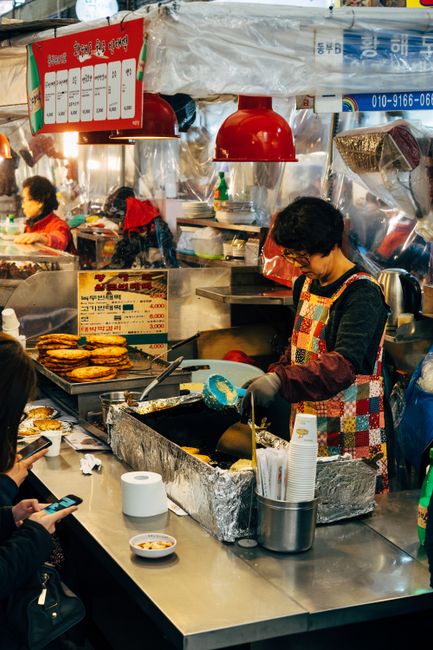
Here is the irony that cuts deepest at Gwangjang Market: you do not need to read a single word to eat brilliantly here. The menu is visual. Point at what’s being made in front of you. Watch what the person next to you ordered. Follow the smell. Korea’s literacy rate sits at approximately 97.9% (UNESCO, 2022) — among the highest in the world — yet the most effective navigation tool inside this market remains entirely pre-linguistic. The eyes. The nose. The willingness to sit down next to a stranger and eat something you cannot name.
This is the agreeable paradox of night market culture: a society that prizes education, credentials, and written communication produces gathering spaces that operate entirely on instinct and sensory trust. Foreign visitors who arrive anxious about the language barrier often report that Gwangjang is the easiest place in Seoul to eat. Because nobody needs to explain bindaetteok (빈대떡). You watch it being pressed onto the griddle, you smell the mung bean batter crisping in oil, and you already know you want one.
📍 Gwangjang Market
- Address: 88 Changgyeonggung-ro, Jongno-gu, Seoul
- Hours: Daily 9:00 AM – 11:00 PM (individual vendors vary; food stalls most active after 6:00 PM)
- Admission: Free
- Getting there: Seoul Metro Line 1, Jongno 5-ga Station (\uc885\ub85c5\uac00\uc5ed), Exit 8 — 2-minute walk
- Official site: http://www.kwangjangmarket.co.kr
Dongdaemun Design Plaza Area: The Night Market That Reinvented Itself
Dongdaemun (동대문) operates on a different logic. Where Gwangjang is ancient and dense, the street food scene around Dongdaemun Design Plaza sprawls and modernizes. The area’s wholesale fashion markets — many of which operate exclusively between midnight and 6 a.m. — created an entire ecosystem of late-night eating built around workers, buyers, and the insomniacs who trail behind them.
The street stalls here run parallel to one of Seoul’s most photographed architectural landmarks. Zaha Hadid’s DDP building, completed in 2014 at a cost of approximately 484 billion Korean won (roughly $370 million USD at 2014 exchange rates), rises from the same ground where vendors sell sundae (순대) — blood sausage stuffed with glass noodles — for around 4,000 to 5,000 won per serving. That contrast is not accidental irony. It is Seoul’s operating mode: radical architectural ambition sitting comfortably alongside food that costs less than a subway ride in most Western cities.
The value proposition here is stark. A full meal — tteokbokki, sundae, eomuk (어묵) fish cake skewers, and a cup of broth — runs between 8,000 and 15,000 won. That is roughly $6 to $11 USD (2024 exchange rates). In comparable cities — Tokyo, Hong Kong, London — a street food equivalent would cost two to three times as much.
📍 Dongdaemun Design Plaza (DDP) Area Night Food Stalls
- Address: 281 Eulji-ro, Jung-gu, Seoul (DDP main entrance reference point)
- Hours: Street vendors typically active from 6:00 PM to 4:00 AM; peak hours 10:00 PM – 2:00 AM
- Admission: Free (street access)
- Getting there: Seoul Metro Lines 2, 4, and 5, Dongdaemun History & Culture Park Station (동대문역사문화공원역), Exits 1 or 2
- Official site: https://www.ddp.or.kr/eng
The Scenario Nobody Tells You About
It is 1:30 a.m. You have been at Dongdaemun for three hours. You ate something from a stall whose name you photographed but cannot pronounce. Now your stomach is sending signals that range from ambiguous to alarming. Your hotel is a 25-minute subway ride away — but the last train on your line left at 12:30 a.m.
This is not a hypothetical. It is the most common night market crisis foreign visitors face in Seoul, and almost nobody prepares for it.
Seoul’s metro system — one of the most extensive in Asia, covering 23 lines and over 340 stations (Seoul Metro, 2023) — runs its last trains between midnight and 1:00 a.m. depending on the line. After that, the city runs on taxis and the Owl Bus (올빼미버스) network, Seoul’s late-night bus service operating on 9 routes from approximately 11:30 p.m. to 4:00 a.m. Kakao T (카카오T), the dominant taxi-hailing app in Korea, works in English and accepts foreign credit cards. Download it before you go out. Not as a backup plan. As standard equipment.
If the stomach situation escalates: GoodDoc (\uad7f\ub2e5) and the KakaoHealth platform list 24-hour clinics near major market areas. Eulji Hospital near Dongdaemun has emergency services around the clock. Most front-desk staff at major hospitals in central Seoul have access to translation support, and the Korea Tourism Organization operates a 24-hour helpline for foreign visitors at 1330 (dial directly from any Korean phone or add +82-2 from abroad).
The night market is generous. The infrastructure around it requires homework.
Namdaemun Market: The One That Wakes Up Before the City Does
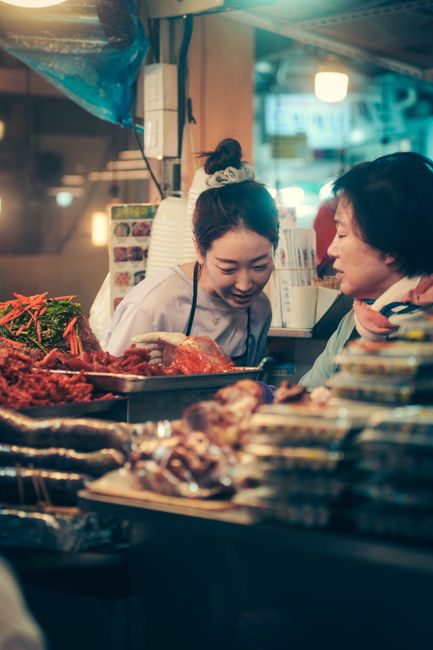
Most night markets thrive on late hours. Namdaemun (남대문) inverts the logic entirely. The market’s most intense activity begins around 11:00 p.m. and peaks in the early morning hours — not because of nightlife, but because of the wholesale trade cycle. Merchants restocking their shops arrive before dawn. The food vendors who feed them have been operating since before midnight.
Galchi jorim (갈치조림) — braised cutlassfish in spicy sauce — appears at stalls here at hours when most cities haven’t yet started making coffee. Kalguksu (칼국수), hand-cut noodle soup, runs from enormous aluminum pots that have been simmering since the previous evening. The broth at the best stalls has a depth that takes twelve hours to build. You taste the time in it.
Namdaemun also carries a specific weight in Korean commercial history. Established in 1414 during the Joseon Dynasty, it has survived Japanese colonial rule, the Korean War, and the complete reconstruction of the surrounding city. The market’s persistence is not nostalgia. It is function. It exists because it works.
📍 Namdaemun Market
- Address: 21 Namdaemunsijang 4-gil, Jung-gu, Seoul
- Hours: Most vendors open 24 hours or from 11:00 PM through early morning; some sections close Sunday
- Admission: Free
- Getting there: Seoul Metro Line 4, Hoehyeon Station (회현역), Exit 5 — 1-minute walk
- Official site: https://www.namdaemunmarket.co.kr
What You Actually Pay and What You Actually Get
The value at Seoul’s night markets is real, but it is not uniform. Knowing the difference between a fair price and a tourist markup matters — especially at Gwangjang, where some vendors near the main entrance charge 30 to 40 percent more than stalls twenty meters deeper into the market. Walk in. Keep walking. The prices drop and the quality often rises.
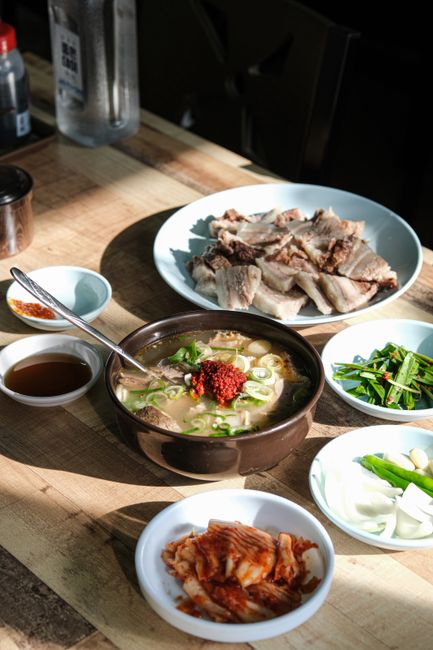
Benchmarks as of 2024: bindaetteok at Gwangjang runs 4,000 to 5,000 won at fair-priced stalls. Mayak gimbap (마약김밥) — the market’s famous miniature rice rolls — costs around 3,000 won for a plate. Tteokbokki at Dongdaemun area stalls averages 4,000 to 5,000 won for a single serving. Sundae with offal (soondae-gukbap, 순대국밥) at Namdaemun runs 8,000 to 10,000 won for a full soup bowl.
Cash is still king at traditional stalls, though an increasing number of vendors accept card payment via mobile terminals. Carry at minimum 30,000 won in small bills on any night market visit. ATMs are available throughout all three market areas; Woori Bank and Shinhan Bank ATMs reliably support foreign cards. To get the most out of your Seoul night market experience, consider booking a guided food tour in advance — the logistics support alone is worth it. And make sure you pick up a Korean eSIM before you land, so maps, translation apps, and ride-hailing work from the moment you step off the plane.
Rover’s Take
Seoul’s night markets survived colonization, war, and the relentless pressure of modernization not because they were protected — but because they were too useful to die.