
Midnight hits Seoul, and the streets don’t empty — they ignite.
Across Korea, the moment the sun drops, a parallel economy switches on. Carts roll out, gas burners hiss, and the smell of frying dough and simmering broth cuts through the night air. This is pojangmacha (포장마차) culture — and it has been feeding Koreans, and now curious travelers, for decades.
It is not a food court. It is not a night market in the sanitized, Instagram-curated sense. A pojangmacha is a tented street stall, often barely larger than a dining table, where strangers share stools and soju under orange plastic sheeting. The food is cheap, fast, and aggressively good.
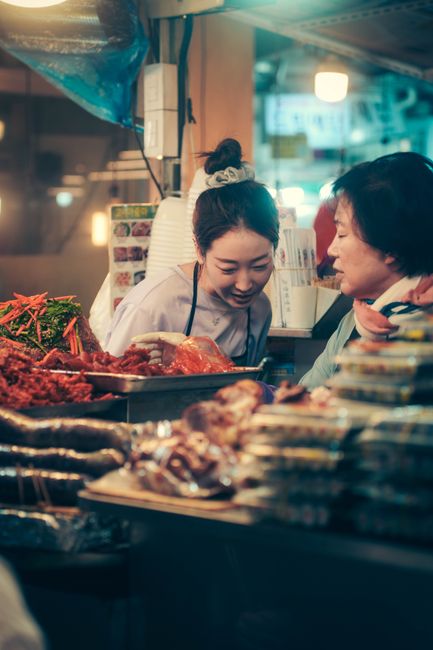
What a Pojangmacha Actually Is — And Why It Survived Modernization
Seoul alone had an estimated 10,000 pojangmacha stalls at their peak in the 1980s. Municipal crackdowns, urban redevelopment, and hygiene regulations cut that number significantly by the 2010s — yet the culture refused to die. Night markets like Gwangjang Market (광장시장) and Namdaemun Market (남대문시장) absorbed much of the demand, while newer formats like Hongdae’s weekend street stalls and Busan’s Gukje Market (국제시장) area evolved the tradition into something more visible to tourists.
The reason pojangmacha survived is not nostalgia. It’s economics. A full meal — tteokbokki (떡볶이), sundae (순대), and a cup of eomuk (어묵) broth — costs between 5,000 and 10,000 KRW (roughly $3.70–$7.40 USD as of 2024). That price point exists nowhere else in a city where a café Americano runs 5,000 KRW.
Affordability is the architecture of this culture.
The Lineup: Five Foods You Will Actually Encounter
1. Tteokbokki — The Unavoidable One
Cylindrical rice cakes in a sauce built from gochujang (고추장, fermented chili paste), sugar, and fish stock. The heat level ranges from mild-ish to genuinely punishing, depending on the vendor. Modern variations add cheese, cream, or rabokki (라볶이) — a hybrid with ramen noodles folded in. A single serving typically runs 3,000–5,000 KRW.
First-timers underestimate the sauce. Don’t.
2. Eomuk — The One Everyone Drinks
Fish cake skewers, simmered in a light kelp-and-anchovy broth. The skewer is almost incidental — vendors hand you a paper cup of the broth for free, and on a night below 5°C, that cup is worth more than the food itself. Seoul in January averages 0–3°C, and eomuk stalls quietly become the city’s de facto warming stations.
3. Sundae — Not What You Think
Korean sundae is a blood sausage — pork intestine packed with glass noodles, barley, and congealed blood, then steamed. It arrives sliced, with salt and gochugaru (고추가루, chili flakes) on the side. The texture is dense and earthy. It pairs with soju in a way that’s hard to explain and immediately obvious after the first bite.
Travelers who skip it because of the name miss the point entirely.
4. Hotteok — Street Dessert That Ends Arguments
Hotteok (호떡) is a pan-fried dough pocket filled with brown sugar, cinnamon, and crushed peanuts. The filling liquefies during cooking. Bite in too fast and molten sugar will find your tongue before you’re ready for it. Vendors near Insadong (인사동) and Myeongdong (명동) move upward of 200 pieces per hour on weekend evenings, according to vendor estimates collected by local food bloggers in 2023.
5. Pajeon — The Rainy Night Standard
Pajeon (파전) is a scallion pancake, usually loaded with seafood. There’s a Korean cultural belief — backed by zero meteorological science and total social consensus — that rain makes you crave pajeon. The sound of rain drumming on a tent roof, a griddle sizzling nearby, and a bottle of makgeolli (막걸리, milky rice wine) in hand: it’s a specific sensory package that Koreans describe as jeong (정) — a word that translates loosely as emotional attachment, and not at all accurately.

Where to Go: The Three Circuits That Actually Deliver
Not every night market is equal. Tourist-facing stalls in Myeongdong have adjusted their menus and prices upward to meet international demand. The real pojangmacha experience requires stepping slightly off the main drag. You can book guided tours in advance to these markets or explore them independently.
📍 Gwangjang Market (광장시장)
- Address: 88 Changgyeonggung-ro, Jongno-gu, Seoul
- Hours: Daily 9:00 AM – 11:00 PM (inner food stalls often open until midnight)
- Admission: Free
- Getting there: Seoul Metro Line 1 or 5, Jongno 5-ga Station, Exit 8
- Official site: http://www.kwangjangmarket.co.kr
📍 Namdaemun Market (남대문시장)
- Address: 21 Namdaemunsijang 4-gil, Jung-gu, Seoul
- Hours: Most stalls open 24 hours; peak night activity from 10:00 PM onward
- Admission: Free
- Getting there: Seoul Metro Line 4, Hoehyeon Station, Exit 5
- Official site: https://www.namdaemunmarket.co.kr
📍 Hongdae Street Market Area (홍대 거리)
- Address: Wausan-ro, Mapo-gu, Seoul (pedestrian zone near Hongik University main gate)
- Hours: Weekend evenings from approximately 6:00 PM; varies by season
- Admission: Free
- Getting there: Seoul Metro Line 2 or Airport Railroad, Hongik University Station, Exit 9
- Official site: N/A
The Practical Scenario: You Don’t Speak Korean, It’s 11 PM, and You’re Hungry
This is not hypothetical. It’s the exact situation most first-time visitors to Seoul face after a long arrival day or a late evening out.
Most pojangmacha vendors operate with zero English menus. Some have laminated photo boards — point at the picture, hold up fingers for quantity, hand over cash. Card payments are increasingly accepted at larger stalls, but carry 10,000–20,000 KRW in cash as a baseline. Kakao Maps (available in English) labels most major market stalls by name and tracks operating hours more accurately than Google Maps for this category of venue. When you arrive, stay connected with a Korean eSIM so these tools are actually usable the moment you land.
If you’re alone at a stall with no shared language, the transaction still works. Vendors in high-traffic tourist areas have processed thousands of these exact interactions. The communication gap is real — and entirely manageable with a finger-point and a nod.
One genuine risk: alcohol. Soju is served openly at pojangmacha stalls, and the social norm is to drink freely with strangers. If you’re not drinking, a firm hand-wave is universally understood. No explanation needed.
If you feel unwell after eating — food sensitivity, not food safety, is the more common issue given the high chili content — convenience stores (CU, GS25, 7-Eleven) stock antacids and basic medication around the clock. The nearest major hospital with English interpretation services in central Seoul is Seoul National University Hospital (서울대학교병원) in Jongno-gu, reachable by taxi in under 15 minutes from most central market areas.

Timing the Visit: When the Culture Is Actually Alive
Pojangmacha culture peaks between October and February. Cold weather drives demand for hot broth, warm dough, and the particular intimacy of small tented spaces packed with strangers. Summer stalls exist but feel different — less urgent, less atmospheric. The sweet spot is a weeknight between 8 PM and midnight, when the after-work crowd overlaps with the late-night crowd and the stalls hit full capacity.
Weekends in tourist-dense areas like Myeongdong run hotter and louder. Weeknights in residential neighborhoods — Mangwon (망원), Seongsu (성수), Euljiro (을지로) — run quieter and far more local. The food quality gap between tourist-facing and neighborhood stalls is measurable. Locals do not accept bad tteokbokki.
The orange tent is not decoration. It is the entire point — the enclosure that turns strangers into temporary neighbors for the length of one paper cup of broth.
What This Culture Is Not
It is not a theme park version of Korean food. It is not curated for dietary restrictions — vegetarians will find the options narrow, as fish stock and pork appear in most base preparations. It is not quiet. And it was not designed to be photographed, though that hasn’t stopped anyone.
The pojangmacha exists at the intersection of affordability, informality, and a very specific Korean relationship with nighttime sociality. It’s where office workers decompress, where arguments get resolved over soju, and where the city’s pretense drops for a few hours.
It outlasted urban planning. It outlasted food safety panics. It outlasted the rise of delivery apps — which now, somewhat absurdly, deliver pojangmacha food to apartment doors. That fact somehow makes the original stall more compelling, not less.
Rover’s Take
A culture that feeds you well for under $5 at midnight, requires no reservation, and asks nothing of you except that you sit down — that’s not a trend. That’s infrastructure.