
Three shopping districts. One city. Completely different universes.
Seoul doesn’t do shopping the way other cities do. It doesn’t funnel tourists into one sanitized mall and call it a day. Instead, it splits its retail energy across neighborhoods so distinct from each other that visiting all three in a single day feels like crossing three different countries. Myeongdong (명동), Hongdae (홍대), and Gangnam (강남) — each one has a personality, a price point, and a crowd that belongs entirely to itself.
Myeongdong: The Machine That Never Sleeps
On a Saturday evening during peak tourist season, Myeongdong’s main pedestrian strip sees an estimated 1 to 2 million visitors over a single weekend — a number that rivals the daily footfall of some European capitals’ entire city centers. The street is roughly 1 kilometer long. Do the math.
This is Seoul’s most internationally recognized shopping corridor, and it earns that title through sheer, relentless density. K-beauty is the engine. Brands like Innisfree, Etude House, Olive Young, and Nature Republic stack up block after block, sometimes two or three competing outlets of the same chain within a 200-meter stretch. The logic is volume. Tourists arrive by the busload, spend fast, and leave. The district is engineered for exactly that.
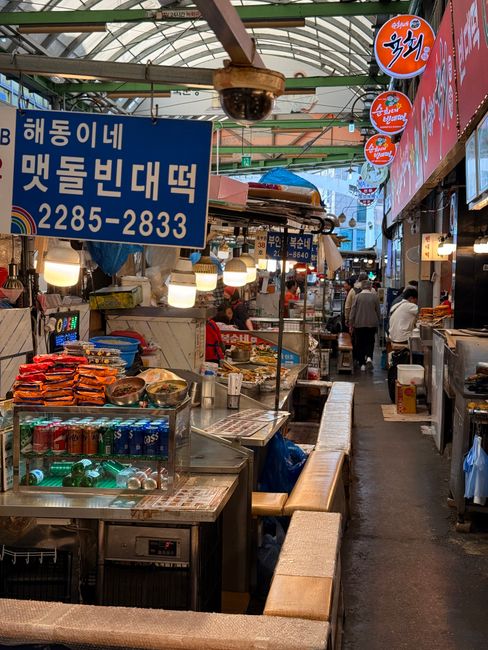
Street food vendors set up by 5 PM and run until midnight. Skewered lobster tails, tornado potatoes, hotteok (호떡) — sweet pancakes stuffed with brown sugar and nuts — line the curbs in a haze of sizzling oil and caramelized sugar. Prices hover between 2,000 and 8,000 KRW per item, roughly $1.50 to $6 USD. Cheap enough to eat standing up. Efficient enough to keep walking.
The language barrier here is the lowest of the three districts. Most vendors speak basic English, Japanese, and Mandarin. Signage is multilingual. Credit cards are universally accepted. For a first-time visitor who hasn’t yet calibrated to Seoul’s pace, Myeongdong is the easiest entry point — not because it’s gentle, but because it’s built to absorb foreigners without friction. The counterintuitive truth? That frictionlessness is itself a kind of trap. You can spend two hours here and leave having experienced Seoul’s most tourist-facing face while missing everything underneath it.
Practical scenario: You’ve just landed at Incheon, taken the AREX express train to Seoul Station, and your hotel is near Myeongdong. It’s 8 PM. You’re jet-lagged but you want to move. Myeongdong is a 10-minute walk from Seoul Station Exit 6. Everything is open. The street is lit like noon. You don’t need a plan.
📍 Myeongdong Shopping Street
- Address: Myeongdong-gil, Jung-gu, Seoul
- Hours: Shops typically 10:00 AM – 10:00 PM; street food vendors 5:00 PM – midnight
- Admission: Free
- Getting there: Seoul Metro Line 4, Myeongdong Station (명동역), Exit 6
- Official site: https://www.visitseoul.net

Hongdae: Where the Price Tag Is Secondary to the Vibe
Hongdae (홍대) doesn’t want to sell you something. It wants to convince you that you discovered it yourself.
Built around Hongik University — one of South Korea’s most prestigious art and design schools — this district grew organically from student culture into a global reference point for indie fashion, vinyl records, handmade accessories, and underground music. The commercial infrastructure followed the subculture, not the other way around. That sequence matters. It’s why Hongdae still feels different from a planned retail zone even as international chains have steadily moved in over the past decade.
The shopping here is tactile and unpredictable. Independent boutiques rotate their stock constantly. A store selling hand-dyed linen jackets one month might pivot to ceramic jewelry the next. Vintage stores — and there are dozens — price their items on condition and rarity rather than brand recognition. A quality vintage denim jacket runs anywhere from 15,000 to 80,000 KRW ($11–$60 USD), depending entirely on which shop you walk into and how well you negotiate.
The weekend flea market at Hongdae Playground (홍대 놀이터) is the district’s most democratic space. Local designers, art students, and independent craftspeople set up stalls from around 1 PM on Saturdays and Sundays — weather permitting, typically March through November. This is where you find things that exist nowhere else: hand-lettered prints, upcycled clothing, resin jewelry cast in small batches. Nothing here is mass-produced. Nothing here is guaranteed to be available next week.
The crowd skews younger than Myeongdong. Domestic Korean shoppers in their late teens and twenties dominate, but the area pulls a significant international population too — particularly travelers who’ve done enough research to know that Myeongdong is the obvious choice and Hongdae is the interesting one.
📍 Hongdae Shopping Area
- Address: Wausan-ro, Mapo-gu, Seoul (centered around Hongik University entrance)
- Hours: Shops vary; most open 12:00 PM – 10:00 PM. Weekend flea market approx. 1:00 PM – 6:00 PM (Sat–Sun, seasonal)
- Admission: Free
- Getting there: Seoul Metro Line 2, Hongik University Station (홍대입구역), Exit 9
- Official site: https://www.visitseoul.net

Gangnam: Shopping as Status Architecture
Gangnam (강남) is not a shopping district. It is a demonstration.
The area south of the Han River became the symbolic center of South Korea’s economic ascent in the 1980s and 1990s, and its retail landscape has never stopped performing that role. The main arteries — Apgujeong Rodeo Street (압구정 로데오거리), Cheongdam-dong (청담동), and the COEX Mall complex — form a triangle of wealth that operates by different rules than anything north of the river.
Flagship stores for Chanel, Louis Vuitton, Gucci, and Dior cluster in Cheongdam-dong at a density that rivals Paris’s Avenue Montaigne or Milan’s Via Montenapoleone. These are not outlet locations or secondary markets. They are full flagship operations, often with architecture commissioned specifically for the Seoul address. The Dior flagship in Cheongdam-dong features a facade designed to reference the traditional Korean pojagi (보자기) wrapping cloth — a detail that costs serious money and signals serious intent.
For visitors outside the luxury market, Gangnam still delivers. COEX Mall — one of Asia’s largest underground shopping complexes — holds over 260 stores, a major aquarium, a casino, a convention center, and the Starfield Library (별마당 도서관), an architectural centerpiece that has become one of Seoul’s most photographed interior spaces. The soaring shelves packed floor to ceiling with books feel almost absurdly grand, like someone decided a shopping mall needed a cathedral. Entry to the mall and library is free. The aquarium is not.
Price points across Gangnam run consistently 20 to 40 percent higher than equivalent goods in Myeongdong or Hongdae. That gap is not a mistake. It is the product.
Practical scenario: You’re traveling with a colleague who wants to buy a high-end Korean skincare gift set — the kind that comes in a box, not off a street stall. Gangnam’s department stores (Hyundai, Galleria) carry curated selections of premium domestic brands like Sulwhasoo and History of Whoo that are harder to find at full range in Myeongdong’s mass-market corridors. Staff at Galleria’s beauty floor typically speak English. Bring your passport — tax refunds on purchases over 30,000 KRW are processed at the exit desk.
📍 COEX Mall
- Address: 513 Yeongdong-daero, Gangnam-gu, Seoul
- Hours: 10:30 AM – 10:00 PM daily
- Admission: Free (individual attractions priced separately)
- Getting there: Seoul Metro Line 2 or Bundang Line, Samseong Station (삼성역), Exit 5 or 6
- Official site: https://www.coex.co.kr/en
📍 Cheongdam-dong Luxury District
- Address: Cheongdam-dong, Gangnam-gu, Seoul
- Hours: Most flagship stores 11:00 AM – 8:00 PM
- Admission: Free
- Getting there: Seoul Metro Line 7, Cheongdam Station (청담역), Exit 8
- Official site: https://www.visitseoul.net
The Comparison That Actually Matters
Stripped down to essentials, the three districts answer three different questions.
- Myeongdong answers: What does Seoul sell to the world? K-beauty, street food, accessible fashion, zero friction for foreign visitors.
- Hongdae answers: What does Seoul make for itself? Independent design, youth culture, things that won’t exist in a chain store six months from now.
- Gangnam answers: What does Seoul aspire to? Luxury, architecture, the performance of having arrived.
None of the three is more “authentic” than the others. Authenticity is a tourist concept. All three are real Seoul — just different registers of the same city.
Budget travelers will extract maximum value from Hongdae’s flea markets and Myeongdong’s street food. Mid-range shoppers will find the sweet spot in Myeongdong’s K-beauty stores and Hongdae’s indie boutiques. Luxury shoppers will find in Gangnam exactly what they came for — and pay exactly what that costs.
The only genuine mistake is treating any one district as the whole picture.
Getting Between All Three: The Logistics
Seoul’s subway system connects all three districts cleanly. Myeongdong to Hongdae is roughly 20 minutes by metro — Line 4 to Line 2, transferring at Dongdaemun History & Culture Park Station. Hongdae to Gangnam’s COEX area runs about 35 minutes on Line 2 directly to Samseong Station. A single T-money card fare between any two points costs between 1,400 and 1,800 KRW as of 2024. Under $1.50 USD per trip.
Taxis are available but rarely worth it for these routes. During peak hours — 6 to 8 PM on weekdays — surface traffic in central Seoul can turn a 20-minute subway ride into a 50-minute cab crawl. The subway wins, every time. If you’re planning to book tours in advance that cover multiple districts, pick up a rechargeable T-money card and stay connected with mobile data for navigation between neighborhoods.
Rover’s Take
Seoul built three completely different shopping worlds within 30 minutes of each other. The real flex isn’t the stores. It’s the subway that connects them.