
Seoul doesn’t ease you in. The first skewer hits before you’ve even found your footing — smoke, chili oil, and something caramelized you can’t quite name. That’s the point.
Street food in Seoul (서울) is not a tourist amenity. It is the city’s nervous system. An estimated 15,000-plus street food vendors operate across Seoul’s districts — a figure that dwarfs comparable markets in Bangkok or Taipei when measured per square kilometer of urban density. The stalls don’t wait for you to be ready.
Where the Real Eating Happens: Five Districts, Five Completely Different Worlds
Most visitors make one mistake: they treat Seoul street food as a checklist. Tteokbokki (떡볶이) here, hotteok (호떡) there, done. That approach misses everything. Each district runs on its own logic, its own rhythm, its own unspoken rules about what you order and when.
Gwangjang Market (광장시장): The One That Started It All
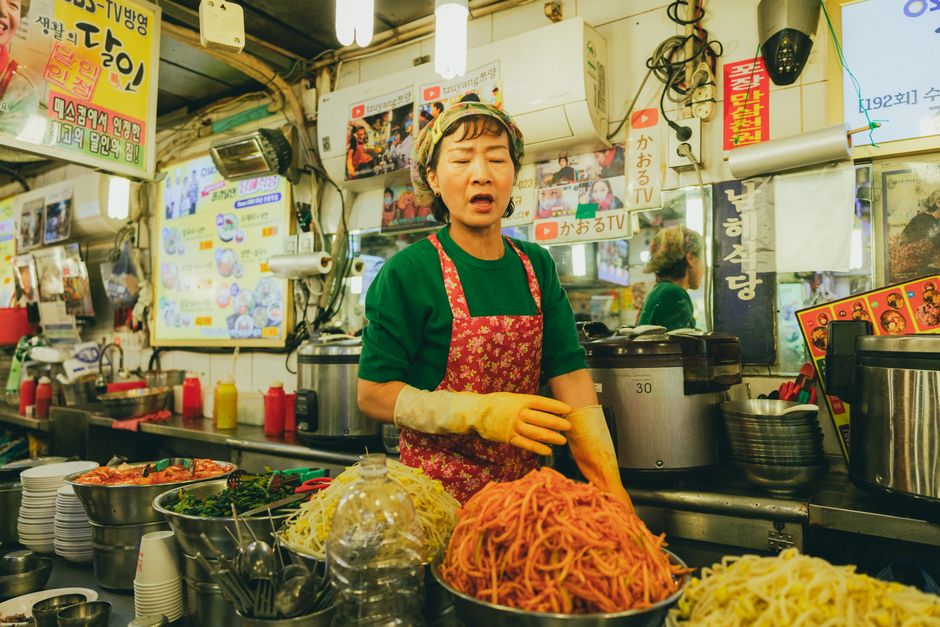
Gwangjang Market has been operating since 1905 — older than the Republic of Korea itself. The raw bindaetteok (빈대떡) stalls at the heart of the market have occupied roughly the same positions for three generations. The women frying them are not performing tradition. They are tradition.
Arrive before noon. The mung bean pancakes are crispest in the morning, before the oil has been worked through a hundred orders. A single bindaetteok runs around 4,000 KRW — less than a dollar and a half more than a vending machine coffee in the airport arrivals hall. The mayak gimbap (마약김밥) stalls nearby sell thumb-sized rolls for 3,000 KRW per plate. The name translates, without exaggeration, to “narcotic rice rolls.”
The market doesn’t explain itself. You walk in, you point, you eat. Language is optional here — hunger is universal.
📍 Gwangjang Market
- Address: 88 Changgyeonggung-ro, Jongno-gu, Seoul
- Hours: Daily 09:00–23:00 (individual vendors vary)
- Admission: Free
- Getting there: Jongno 5-ga Station (Line 1), Exit 8 — 2-minute walk
- Official site: https://www.gwangjangmarket.co.kr
Myeongdong (명동): The Spectacle Market
Myeongdong is loud, crowded, and deliberately theatrical. That’s not a flaw — it’s the product. Vendors here have evolved to compete with neon signage and K-beauty storefronts for your attention. The result is street food as performance: tornado potatoes spiraled on a skewer, lobster tails split and torched tableside, corn dogs (핫도그) coated in french fries and dusted with sugar.
The sugar-on-corn-dog move baffles first-timers every single time. It shouldn’t. The sweet-savory contrast is a deliberate design decision, not an accident. Korea’s street food has always iterated fast — faster than any sit-down restaurant culture can. Myeongdong is where that iteration goes public.
Prices run 20–40% higher than Gwangjang, but the density of options within 400 meters of pedestrian street is unmatched anywhere in the city. Peak hours run 18:00–22:00. Before 17:00, the stalls are still setting up and the crowds are manageable.
📍 Myeongdong Street Food Alley
- Address: Myeongdong-gil, Jung-gu, Seoul (pedestrian street running north from Myeongdong Station)
- Hours: Approximately 11:00–23:00 (seasonal variation applies)
- Admission: Free
- Getting there: Myeongdong Station (Line 4), Exit 6 — 1-minute walk
- Official site: https://www.visitseoul.net
Noryangjin Fish Market (노량진수산시장): Eat It While It’s Still Moving
Noryangjin operates on a different clock entirely. The wholesale auction begins at 01:00. By 04:00, the retail floor is already running. By 06:00, the pojangmacha (포장마차) — the tented stalls ringing the market exterior — are serving raw sea cucumber and live octopus to workers who have been on their feet for five hours already.
This is not a curated experience. The floor is wet. The lighting is industrial. The haenyeo-caught abalone in tank six doesn’t care that you’re jet-lagged. But the protocol is straightforward: choose your seafood from the vendor stalls on the lower floor, pay per kilogram, then carry it upstairs to one of the cooking restaurants. They’ll prepare it — steamed, grilled, or raw — for a small preparation fee (typically 5,000–10,000 KRW depending on the dish).
📍 Noryangjin Fish Market
- Address: 674 Nodeul-ro, Dongjak-gu, Seoul
- Hours: 24 hours (wholesale auction from 01:00; retail from approximately 04:00)
- Admission: Free
- Getting there: Noryangjin Station (Line 1 / Gyeongui-Jungang Line), Exit 1 — direct underground connection
- Official site: https://www.susansi.co.kr

The Food Itself: What to Eat and What It Actually Costs
Tteokbokki (떡볶이): The Baseline
Every street food conversation in Seoul eventually returns here. Tteokbokki — cylindrical rice cakes in gochujang (고추장) chili paste — is the gravitational center of Korean street eating. The dish has existed in some form since the Joseon Dynasty, though the red chili version is a post-1950s development; gochujang itself only became widely affordable after Korean War-era American aid introduced mass-produced chili cultivation to the peninsula.
A standard portion at a street stall: 3,000–5,000 KRW. The same dish at a sit-down restaurant in Gangnam (강남): 12,000–18,000 KRW. Same rice cakes. Different rent.
Eomuk (어묵): The One You’ll Eat Standing in the Cold
Fish cake skewers simmering in anchovy broth. The broth is free — refillable, drinkable, served in a small paper cup from a ladle hanging on the cart. In January, when Seoul drops to -10°C (14°F), the eomuk cart becomes a survival station. Locals wrap both hands around the cup and don’t apologize for standing there longer than necessary.
Price: 500–1,000 KRW per skewer. The broth costs nothing. That math is not a mistake.
Hotteok (호떡): The One That Burns Your Mouth Every Time
A fried dough pancake filled with brown sugar, cinnamon, and crushed peanuts. The filling liquefies during cooking. It will burn you. You will eat it anyway. The vendors near Insadong (인사동) sell a green tea variation; the ones in Namdaemun Market (남대문시장) stick to the original. Both are correct.
📍 Namdaemun Market
- Address: 21 Namdaemunsijang 4-gil, Jung-gu, Seoul
- Hours: Most vendors open 24 hours; peak activity 06:00–18:00
- Admission: Free
- Getting there: Hoehyeon Station (Line 4), Exit 5 — 1-minute walk
- Official site: https://www.namdaemunmarket.co.kr
The Practical Layer: What No One Tells You Before You Go
Cash, Cards, and the Gap Between Them
As of 2024, approximately 60% of Seoul street vendors accept card payment — a dramatic shift from even five years prior, when cash was near-universal. But that 40% gap will catch you at the worst moment: hungry, deep in a market, staring at a tteokbokki cart with a hand-lettered “현금만” (cash only) sign you can’t read.
Carry a minimum of 30,000 KRW in small bills at all times. The ATMs inside GS25 and CU convenience stores — which appear every 200 meters in central Seoul — accept foreign cards and charge a flat fee of around 3,000 KRW per transaction. That fee is cheaper than the frustration of missing a meal.
Real Scenario: The Allergy Problem at Midnight
It’s 23:30. You’ve eaten something from a cart near Hongdae (홍대) and your throat feels wrong. Not emergency-wrong, but wrong enough to worry. Here’s the actual sequence: the nearest 24-hour pharmacy (약국) will be within 500 meters of any major station — look for the green cross sign. Show the pharmacist your symptoms; most stock antihistamines and are accustomed to foreign visitors. If symptoms escalate, Severance Hospital (세브란스병원) near Sinchon Station operates a 24-hour emergency department with English-speaking staff on rotation. The non-emergency medical interpretation line (1339) operates around the clock and connects to an English speaker within minutes.
Street food in Seoul is overwhelmingly safe. But sesame, shellfish, and gluten appear in dishes that don’t advertise them. Know your triggers before you approach the cart, not after.
Timing the City: When to Move, When to Stop
Seoul’s street food peaks at two distinct windows: 12:00–14:00 (the office lunch exodus) and 19:00–22:00 (the post-work descent). Between those windows, the city breathes. Stalls restock, oil gets changed, vendors eat their own food in folding chairs behind the cart.
The 07:00–09:00 window is underrated. Gwangjang’s inner stalls serve kongnamul gukbap (콩나물국밥) — soybean sprout soup with rice — to market workers who’ve been up since 04:00. The portions are enormous. The price is 6,000–8,000 KRW. The crowd is entirely local. That ratio matters.
Hongdae Street Food Zone (홍대): After Midnight, Everything Changes
Hongdae runs on university time. The street food scene here doesn’t peak until 21:00 and runs until 02:00 on weekends. The demographic shifts accordingly — younger, louder, more experimental. Dakgalbi (닭갈비) stir-fry carts share pavement with bubble tea hybrids and skewers of things that have no traditional name because they were invented last month.
This is where Seoul’s street food culture reveals its true metabolism: relentless, improvisational, indifferent to heritage when something simply tastes better.
📍 Hongdae Street Food Area
- Address: Eoulmadang-ro and surrounding streets, Mapo-gu, Seoul
- Hours: Vendors typically active from 17:00; peak 21:00–02:00 (weekends)
- Admission: Free
- Getting there: Hongik University Station (Line 2 / Airport Railroad / Gyeongui-Jungang Line), Exit 9
- Official site: https://www.visitseoul.net
One Route, One Day: The Street Food Circuit That Actually Works
- 07:30 — Gwangjang Market, kongnamul gukbap. Eat with the market workers.
- 10:00 — Namdaemun Market, hotteok and eomuk. The sugar burns. Worth it.
- 13:00 — Myeongdong pedestrian street, tteokbokki and a tornado potato. Peak crowd, peak energy.
- 16:00 — Insadong, green tea hotteok and traditional rice wine (makgeolli, 막걸리) from a pojangmacha. The pace drops here. Let it.
- 20:00 — Hongdae. Order something you can’t identify. That’s the correct move.
Total spend for the full circuit: approximately 35,000–50,000 KRW (roughly $25–37 USD at 2025 exchange rates). That’s a single main course at a mid-range restaurant in most Western capitals. For the best experience, book tours in advance to pick up insider knowledge, or stay connected with a local eSIM so you can navigate between districts without missing a beat.
Rover’s Take
Seoul’s street food doesn’t need your approval — it was feeding this city long before it became a travel category, and it’ll keep doing so long after the trend pieces move on.