
Six hundred years ago, a king built a palace so vast it could swallow a city block whole. Today, you can walk through its front gate for less than the price of a coffee.
Seoul’s five grand palaces — Gyeongbokgung (경복궁), Changdeokgung (\ucc3d\ub355\uad81), Changgyeonggung (\ucc3d\uacbd\uad81), Deoksugung (\ub355\uc218\uad81), and Gyeonghuigung (\uacbd\ud76c\uad81) — are not monuments frozen in amber. They are contested ground. Burned, rebuilt, occupied, and reclaimed across five centuries of war, colonization, and national resurrection. Walking through them without knowing that history is like reading a novel from the last page.
This is the full story. Start from the beginning.

Gyeongbokgung: The Palace That Refused to Stay Dead
Gyeongbokgung was completed in 1395 — three years after the Joseon Dynasty was founded. At its peak, the compound covered roughly 410,000 square meters, housing over 500 individual structures. For context, that is larger than 57 American football fields placed side by side.
It was burned to the ground during the Japanese invasions of 1592. Left in ruins for 273 years. Rebuilt by the regent Heungseon Daewongun between 1865 and 1868. Then, under Japanese colonial rule beginning in 1910, the colonial government demolished more than 90% of its buildings and erected the Government-General Building directly in front of Gwanghwamun Gate — a calculated act of visual erasure. That building was finally torn down in 1995.
Restoration is still ongoing. As of 2024, approximately 40% of the original structures have been rebuilt. The work is expected to continue past 2045.
The palace was not destroyed once. It was destroyed across three different centuries, by three different forces, for three different reasons. That is not misfortune. That is a pattern.
The most photographed spot is Gyeonghoeru (경회루) — a two-story pavilion set on 48 stone pillars above an artificial pond. Built in 1412 for royal banquets and diplomatic receptions, it survived the fires of 1592 and was rebuilt in 1867. In winter, the pond freezes solid. In summer, lotus blooms fill every frame.
Arrive before 9 a.m. The weekend crowds after 10 a.m. are not merely large. They are a wall.
📍 Gyeongbokgung Palace (경복궁)
- Address: 161 Sajik-ro, Jongno-gu, Seoul
- Hours: 9:00 AM – 6:00 PM (Mar–Oct); 9:00 AM – 5:00 PM (Nov–Feb). Closed Tuesdays.
- Admission: Adults ₩3,000 (approx. USD $2.20, 2024). Free with Hanbok rental.
- Getting there: Gyeongbokgung Station (Line 3), Exit 5
- Official site: https://www.royalpalace.go.kr
Changdeokgung: The One UNESCO Actually Cares About
Of the five palaces, only Changdeokgung holds UNESCO World Heritage status — granted in 1997. The distinction has little to do with the main palace buildings. It is what lies behind them: Huwon (후원), the Secret Garden.
Huwon covers approximately 300,000 square meters of forested hillside. Over 26,000 trees, some more than 300 years old, grow across its terrain. There are ponds, pavilions, a lotus garden, and walking paths that feel nothing like a tourist attraction. They feel like a place someone actually loved.
Changdeokgung was built in 1405 as a secondary palace to Gyeongbokgung. After the invasions of 1592 destroyed both, Changdeokgung was the first to be rebuilt — in 1610 — and it served as the primary royal residence for the next 258 years. The last royal resident, Emperor Sunjong, died here in 1926.
The Huwon tour is separate from general admission and runs on a fixed schedule with a guide. Maximum group size is 50 people. Tickets sell out days in advance during spring and autumn. Book your tour in advance. Not the morning of.
📍 Changdeokgung Palace (창덕궁)
- Address: 99 Yulgok-ro, Jongno-gu, Seoul
- Hours: 9:00 AM – 6:30 PM (Feb\u2013May, Sep\u2013Oct); 9:00 AM – 6:30 PM (Jun–Aug); 9:00 AM – 5:30 PM (Nov–Jan). Closed Mondays.
- Admission: Palace ₩3,000; Huwon (Secret Garden) tour ₩8,000 (2024)
- Getting there: Anguk Station (Line 3), Exit 3
- Official site: https://www.cdg.go.kr
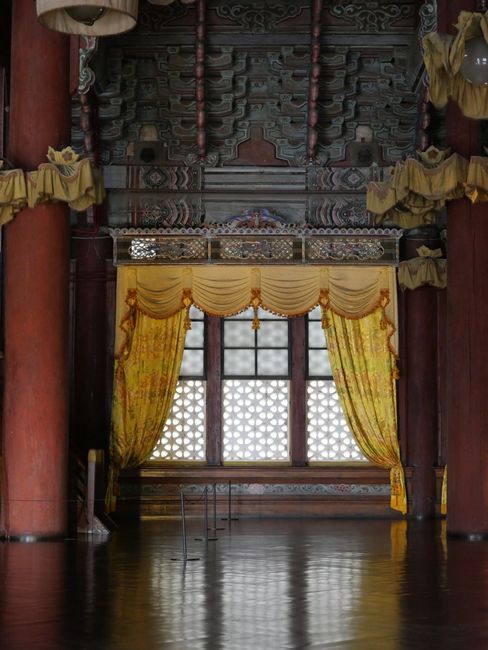
Changgyeonggung: The Palace They Turned Into a Zoo
This is the one most visitors skip. That is exactly why it is worth going.
Changgyeonggung was originally built in 1484 by King Seongjong to house three dowager queens. It was burned in 1592, rebuilt in 1616, and then — in 1909, under Japanese colonial administration — systematically converted into a public zoo and botanical garden. Animals were brought in. Amusement rides followed. The palace was renamed Changgyeongwon (창경원), stripping it of its royal designation entirely.
The zoo operated inside the palace grounds until 1983, when the animals were relocated to Seoul Grand Park in Gwacheon. The palace’s name was restored. The botanical greenhouse — a Victorian-era glass structure built in 1909 — still stands and remains open to visitors. It is the oldest Western-style greenhouse in Korea.
Because Changgyeonggung connects directly to Changdeokgung through a shared wall, the two palaces can be visited together in a single day without backtracking. Most visitors never realize this. Most visitors miss Changgyeonggung entirely.
📍 Changgyeonggung Palace (창경궁)
- Address: 185 Changgyeonggung-ro, Jongno-gu, Seoul
- Hours: 9:00 AM – 9:00 PM (Feb–May, Sep–Oct); 9:00 AM – 9:00 PM (Jun–Aug); 9:00 AM – 9:00 PM (Nov–Jan). Closed Mondays.
- Admission: Adults ₩1,000 (2024)
- Getting there: Hyehwa Station (Line 4), Exit 4; or via internal gate from Changdeokgung
- Official site: https://www.cgg.go.kr
Deoksugung: The Palace Surrounded by Embassies and Ghosts
Deoksugung (덕수궁) is the only palace in Seoul where you can watch a traditional royal guard-changing ceremony with a Starbucks visible in the background. That tension is not accidental. It is the entire point of this place.
The palace sits in the middle of Jung-gu, Seoul’s central business district, ringed by the embassies of the United States, Canada, and the United Kingdom. It was not originally built as a royal palace — it was a private villa that became the last refuge of King Gojong after the main palaces were occupied or destroyed during the turbulent final decades of the Joseon Dynasty.
Gojong declared the founding of the Korean Empire here in 1897 — Korea’s attempt to assert sovereignty in the face of encroaching Japanese and Russian influence. It failed. By 1910, the empire was annexed. Gojong died inside this palace in 1919 under circumstances that have never been officially resolved. Poisoning has been the persistent theory for over a century.
The palace contains Seokjojeon (석조전), a neoclassical Western-style building completed in 1910 — the same year as the annexation. It now functions as the Daehan Empire History Museum. The sight of a Greek-columned imperial hall standing inside a Joseon palace compound tells you everything about the era it was built in: a dynasty racing to modernize fast enough to survive, and failing by the width of a single year.
The guard-changing ceremony runs three times daily at 11:00 AM